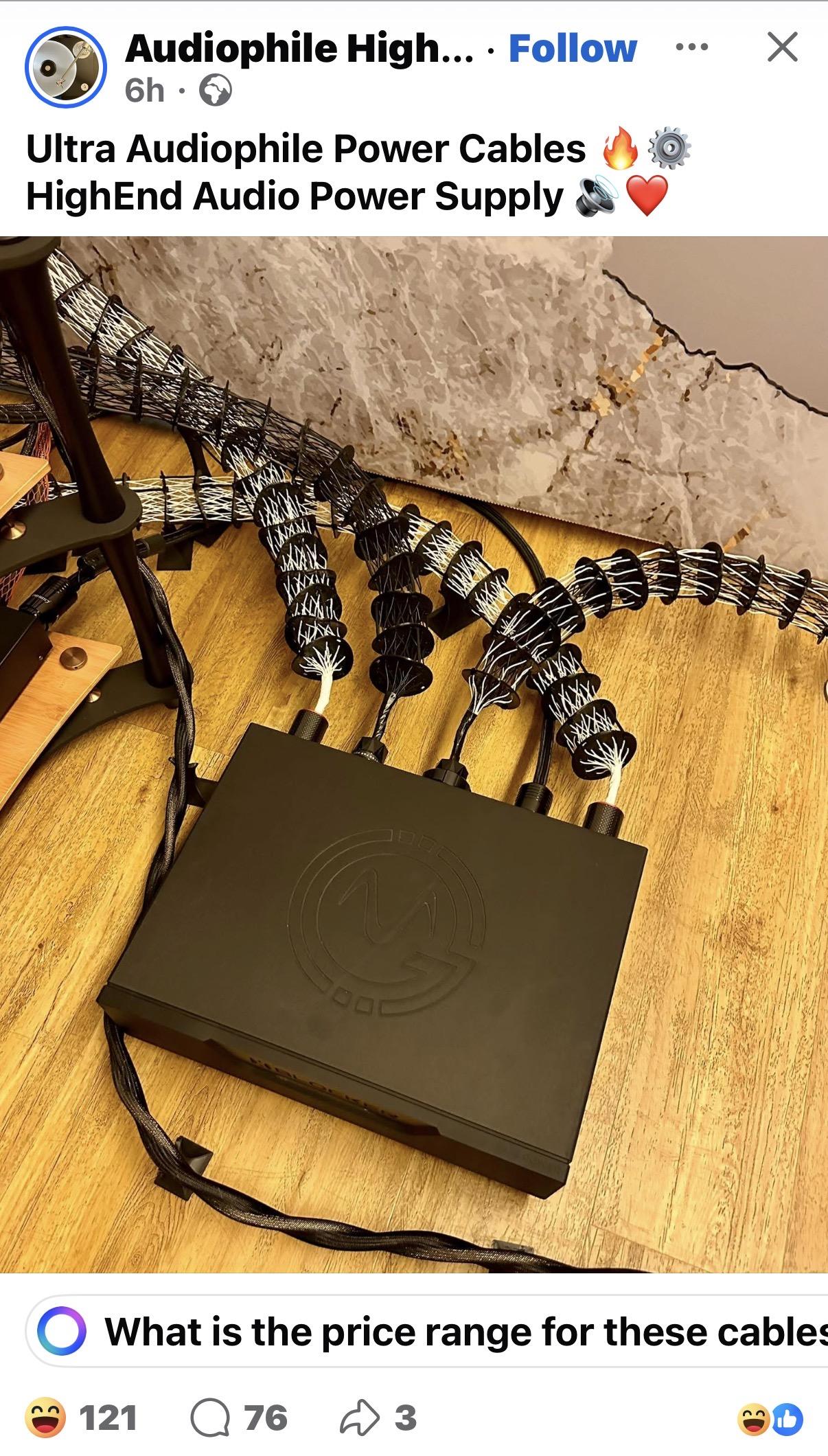
What the, and I cannot overstate this, fuck?
-
What the, and I cannot overstate this, fuck?
@bloor is that a cope cage for the cable within, to defend against FPV drone-armed rabbits who'd like to chew on it ?
-
@secretbatcave @bloor “Loins booming” now there’s a description
@FeloniousPunk @bloor haaa, that was a typo, noise still stands
Probably best to imagine it as Lord flasheart from Blackadder
-
Here's the rest of that setup. Those are *mains power* cables — no bloody way that's legal.
The Reddit thread is fun, too.
https://www.reddit.com/r/audiophile/comments/1nzo3rw/for_true_separation_of_instruments/What's also pretty telling is the "power comes from the wall" mindset underlying this setup.
Unless they added these cables into the walls. And added a ton of filtering and smoothing.
-
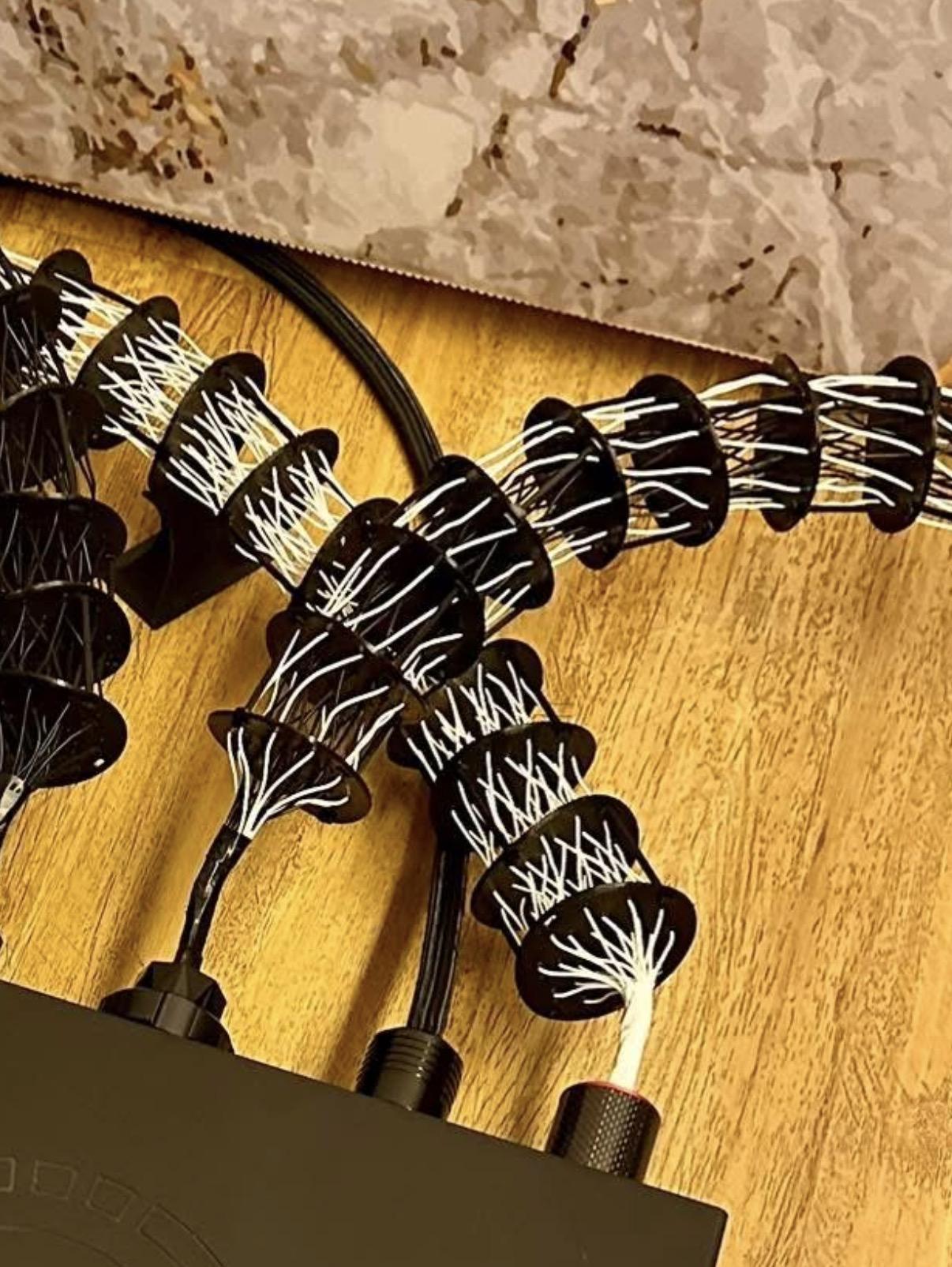
@bloor I think I see what they're trying to do. By breaking the wires up and interweaving them, my guess is they're trying to get the magnetic fields to cancel. Maybe minimize the magnetic coupling between the power and signal lines?
I think any improvement is going to be really minor, but I get it.
I think you could do something similar by splitting power through multiple pairs with differing twist rates (similar to how CAT6 cable is built). But that wouldn't look as AWESOME as this!
@ericphelps there will be zero cancellation though, because they aren’t twisted and (i think) they’re single pole.
To my eye they’ve created a cage dipole. I think if anything it’ll pick up more rubbish.
-
@bloor I recall visiting a high-end audio shop maybe 25-30 years ago. They had a Denon single CD player, almost a cubic foot in volume, for $5000. I asked salesperson about "why?", and among its features was "no stray light can get and interfere with the laser." Hell, a runaway train couldn't budge it. Strangely, I did not purchase it.
That's why cameras are commonly a cubic foot in volume.
-
What the, and I cannot overstate this, fuck?
@bloor this one is a perfect introduction to the game where you reverse engineer the audiophile's understanding of physics and electronics.
It's totally unhinged, and yet I can just see the common simplifications of crosstalk & stray capacitance that the designer latched onto. Amazing.
-
@bloor
Speak to me like I am five and explain to me what is an "audiophile"? (^_^)@hiisikoloart @bloor people who use music to listen to their audio equipment, instead of the other way around.
-
-
Yup. The whole shebang is useless, and (I'm guessing here) probably crazy expensive, too.
Silver wires (high-end audio nearly always uses silver), woven by hand through separators, then all wrapped together and terminated... $$$.
I'd love to see inside that distribution box. A couple of coils and caps, maybe?

-
@bloor Bob Pease (R.I.P.) wrote an article a long time ago about "audiophile" speaker cables. He found plain old zip cord and even ribbon cable was just as effective.
@StumpyTheMutt @bloor
Of course, Pease's conclusion didn't surprise anyone with even modest electronics knowledge, but it is very satisfying to be able to point to the words of one of the all time great EEs, when some audiophool doesn't believe me.
(But audiophools don't believe true experts, either. They only believe their preconceived notions, and those of other audiophools in their echo chambers.) -
What the, and I cannot overstate this, fuck?
The difference between science, engineering and actually understanding the world and magic and mysticism


 ️
️ -
Oh, there are plenty of possibilities to "improve" this design further - or coming up with something else being even more absurd, shifting the revenue stream in your direction. There are always room for "improving" cables and it will always sell.
But you need to be quite cynical playing on the psychology aspects related to making people believe they hear a difference - and have some quasi research papers supporting what they "hear". The rest is plain marketing and marketing strategies.
And don't forget: In this user segment - the sound always gets better the more expensive the cables or equipment is.
Good luck!

-
@bloor How about this one?
-
@bloor ah yes, the maximally untwisted pair, for that extra interference on the signal lines. It greatly improves audio quality, or something.
@sophieschmieg @bloor looks like a antenna to me

-
Here's the rest of that setup. Those are *mains power* cables — no bloody way that's legal.
The Reddit thread is fun, too.
https://www.reddit.com/r/audiophile/comments/1nzo3rw/for_true_separation_of_instruments/ -
@bloor
Speak to me like I am five and explain to me what is an "audiophile"? (^_^)In theory, it’s people who care a lot about audio quality. They often claim to have better than average frequency range in their ears (many do, but a lot claim to hear things only bats can actually hear).
For a long time, a lot of consumer audio equipment was pretty terrible, so there were real reasons for wanting something better, I remember listening to a CD that I’d heard many times on my CD player and ripped to my iPad and discovering that CD player from the ‘80s had completely lost a load of low-volume bits and there was material that would probably have been audible on an expensive player in the ‘80s and was easily audible on a cheap player in the early 2000s.
At the same time, the Loudness War happened. Music execs found that people were more likely to like music if it was loud the first time they heard it. So they started making CDs louder. But CDs have a fixed dynamic range, so making it loader lost detail. They couldn’t do this with records because the needle would jump out of the track, so we had a weird period where LPs had better audio fidelity than CDs. Unfortunately, LPs are really finicky and it’s very easy to scratch them if you don’t perfectly balance the stylus to avoid more than minuscule pressure on the surface.
So, to listen to the highest-quality music, you needed a moderately expensive record deck, a decent amplifier (and pre-amp: again, LPs are annoying to play), and speakers. And it was fairly noticeable if you got any of these wrong.
But then DACs got a lot better. Cheap USB audio adaptors for computers had much better precision than anything available in the ‘80s, and could be placed outside of the case and away from RF interference from the computer. AAC audio supports a variable dynamic range (so bumping the loudness is just a scaling factor, not a loss of precision). Baseline speaker and amplifier quality improved a lot. By the mid 2000s, fairly cheap equipment gave better sound quality than anything you could buy in the ‘90s.
By then, an entire industry had grown up to cater to people who wanted the best sound quality possible and an even larger group of people who wanted to be seen as having the best sound quality. It moved from music appreciation to conspicuous consumption as a primary market driver. And that made it a ripe target for scams.
For analogue things, there were obvious things you could sell, like cables with gold-plated connectors. Gold is a good conductor and, unlike copper, doesn’t corrode, so this would make a difference (whether the difference is audible is another matter). But the move to mostly digital paths made this harder. You got very silly things like ‘audiophile grade’ Ethernet cables and optical connectors, which ignored the fact that the digital protocols had built-in error correction and that audio is staggeringly low bandwidth in comparison to other things carried over these connections so there’s space for a lot of error correction. A load of these things can be run over a wire coathanger with no loss in quality.
The entire ecosystem became dominated by very silly things. But they’re all quite interesting because they have some plausible-looking science behind them, which then goes off in a nonsense direction. For example, Ethernet is an electrical protocol, so signal quality matters. Gold is a good conductor. Gold connectors on Ethernet cables will reduce signal degradation. Pay no attention to the fact that the Ethernet standard is specified based on specifically rated cables and won’t be any better on ones with marginally better connectors.
My guess from the picture is that someone has noticed that electrical noise from a power supply can be a problem and has built something that looks very plausibly like it would solve that.
-
Oh, there are plenty of possibilities to "improve" this design further - or coming up with something else being even more absurd, shifting the revenue stream in your direction. There are always room for "improving" cables and it will always sell.
But you need to be quite cynical playing on the psychology aspects related to making people believe they hear a difference - and have some quasi research papers supporting what they "hear". The rest is plain marketing and marketing strategies.
And don't forget: In this user segment - the sound always gets better the more expensive the cables or equipment is.
Good luck!
@dazo @drwho @tony @bloor Relevant xkcd: https://xkcd.com/670/
-
What the, and I cannot overstate this, fuck?
@bloor I remember the good olden days when every household had some nice, mostly midrange hifi system. Was a bit of a status symbol and I guess mobility and space grew more important for the majority.
And now you only have super enthusiasts or people that listen to audio on a sh.. bluetooth speaker.
On the other hand that allowed me to gather some equipment for cheap.
Addit: preowened 90s /2k midrange stuff
-
@bloor audiophile rocks
Yes they want you to buy rocks meant to improve sound somehow???
These are almost $500 but there's more expensive ones
https://www.ebay.com/itm/296707135133
https://youtu.be/3uCYXER3oZI@Jes @bloor
This revew of audiophile rocks is hilarious. Sadly the website and youtube channel are now closedhttp://www.adventuresinhifiaudio.com/26/01/2018/audiophile-rocks-down-the-rabbit-hole-once-again/
-
What the, and I cannot overstate this, fuck?
@bloor you've heard of twisted pair now get ready for whatever the fuck this is