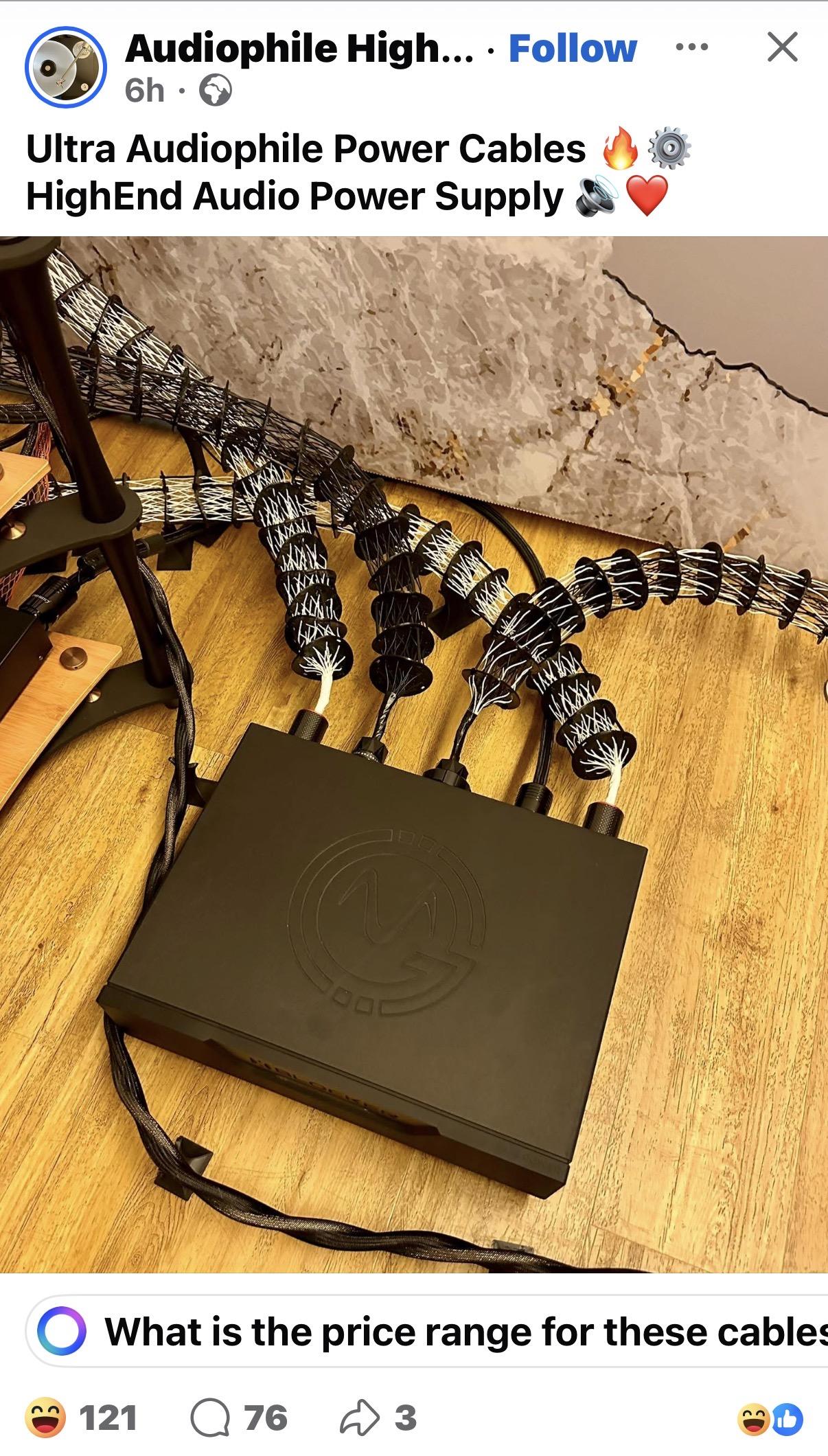
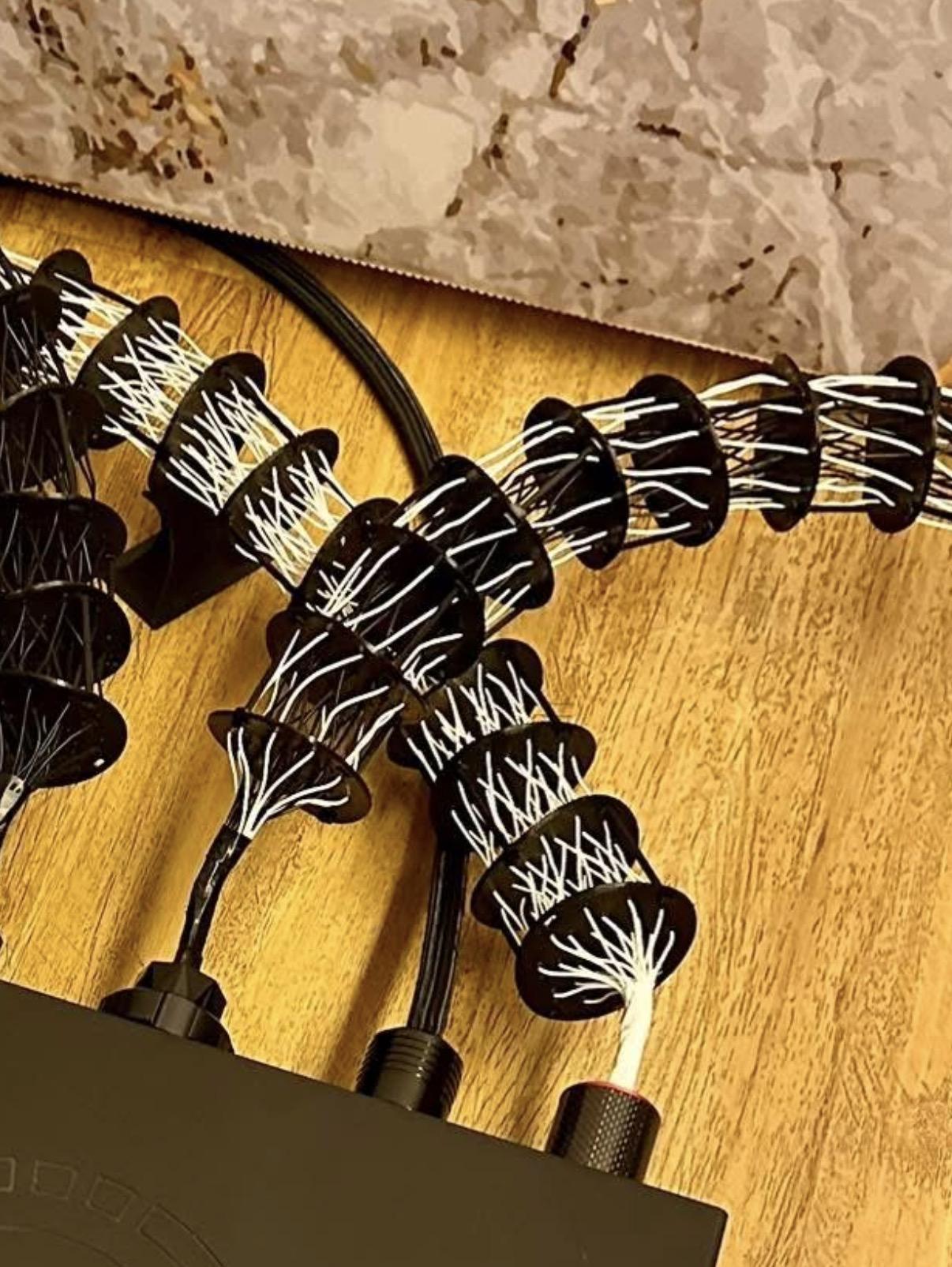
What the, and I cannot overstate this, fuck?
-
@dazo
I got some fancy power cables at wholesale from a friend who worked in an audiophile shop. A few years later I sold them for a profit. They came with zip-up hard cases (disc shaped, for coiling).On a single-blind test in a recording studio, I actually could (just barely) tell a minute difference. Not a night and day thing, just a "If you force me to pick, I prefer sound A to sound B" thing.
(Pro Tools confirmed that this difference was real.) I doubt anyone outside the studio, who wasn't an experienced professional and not listening to calibrated monitors in a treated recording studio, at 24/96, could hear it.)
What really gets me is people who think they can hear the difference between hard disks and ethernet cables. (Unless you have shitty jittery DACs, this is provably impossible.)
The difference in the ProTools checks might have been the cable, but can just as well have been some other related things. Signals can be affected by magnetic interference (audio is AC voltage), so if there are other power cables laying closer or further away from the speaker or signal cables may just be enough to make a slight difference. Or if the cable was too long and curled up vs being straight. In some cases with power cables, other equipments plugged in at the same power outlet may cause a slight difference - due to the power drawn, which impacts the magnetic aspects.
In regards to the magnetism aspects ... you know the amp measurement devices you just clamp over the cable, not actually connecting to wires ... that's just a coil "wrapped around" the cable measuring the magnetic field and from that calculates the amps passing through.
But yeah, for digital signal paths .... it's all in the DAC at that point. Of course, disrupted bits in the transfer can cause noise. But not clarity details. And the digital signal paths certainly has enough error correction to not bit-flip data hitting the DAC in the end. Gee, that's just hilarious.
-
What the, and I cannot overstate this, fuck?
@bloor Staubsauger-Roboter!
-
@bloor Bob Pease (R.I.P.) wrote an article a long time ago about "audiophile" speaker cables. He found plain old zip cord and even ribbon cable was just as effective.
@StumpyTheMutt @bloor for some time there was the thing to minimise resistance of the wire. And audiophiles just used electrical wire, as it was cheaper with a similar cross section than the true audio cables.
-
@hiisikoloart @bloor people who use music to listen to their audio equipment, instead of the other way around.
-
@Jes @bloor
This revew of audiophile rocks is hilarious. Sadly the website and youtube channel are now closedhttp://www.adventuresinhifiaudio.com/26/01/2018/audiophile-rocks-down-the-rabbit-hole-once-again/
-
In theory, it’s people who care a lot about audio quality. They often claim to have better than average frequency range in their ears (many do, but a lot claim to hear things only bats can actually hear).
For a long time, a lot of consumer audio equipment was pretty terrible, so there were real reasons for wanting something better, I remember listening to a CD that I’d heard many times on my CD player and ripped to my iPad and discovering that CD player from the ‘80s had completely lost a load of low-volume bits and there was material that would probably have been audible on an expensive player in the ‘80s and was easily audible on a cheap player in the early 2000s.
At the same time, the Loudness War happened. Music execs found that people were more likely to like music if it was loud the first time they heard it. So they started making CDs louder. But CDs have a fixed dynamic range, so making it loader lost detail. They couldn’t do this with records because the needle would jump out of the track, so we had a weird period where LPs had better audio fidelity than CDs. Unfortunately, LPs are really finicky and it’s very easy to scratch them if you don’t perfectly balance the stylus to avoid more than minuscule pressure on the surface.
So, to listen to the highest-quality music, you needed a moderately expensive record deck, a decent amplifier (and pre-amp: again, LPs are annoying to play), and speakers. And it was fairly noticeable if you got any of these wrong.
But then DACs got a lot better. Cheap USB audio adaptors for computers had much better precision than anything available in the ‘80s, and could be placed outside of the case and away from RF interference from the computer. AAC audio supports a variable dynamic range (so bumping the loudness is just a scaling factor, not a loss of precision). Baseline speaker and amplifier quality improved a lot. By the mid 2000s, fairly cheap equipment gave better sound quality than anything you could buy in the ‘90s.
By then, an entire industry had grown up to cater to people who wanted the best sound quality possible and an even larger group of people who wanted to be seen as having the best sound quality. It moved from music appreciation to conspicuous consumption as a primary market driver. And that made it a ripe target for scams.
For analogue things, there were obvious things you could sell, like cables with gold-plated connectors. Gold is a good conductor and, unlike copper, doesn’t corrode, so this would make a difference (whether the difference is audible is another matter). But the move to mostly digital paths made this harder. You got very silly things like ‘audiophile grade’ Ethernet cables and optical connectors, which ignored the fact that the digital protocols had built-in error correction and that audio is staggeringly low bandwidth in comparison to other things carried over these connections so there’s space for a lot of error correction. A load of these things can be run over a wire coathanger with no loss in quality.
The entire ecosystem became dominated by very silly things. But they’re all quite interesting because they have some plausible-looking science behind them, which then goes off in a nonsense direction. For example, Ethernet is an electrical protocol, so signal quality matters. Gold is a good conductor. Gold connectors on Ethernet cables will reduce signal degradation. Pay no attention to the fact that the Ethernet standard is specified based on specifically rated cables and won’t be any better on ones with marginally better connectors.
My guess from the picture is that someone has noticed that electrical noise from a power supply can be a problem and has built something that looks very plausibly like it would solve that.
@david_chisnall @bloor
That was a lot of interesting words.
Thank you for trying to explain this to me. -
What the, and I cannot overstate this, fuck?
@bloor cat toy
-
Here's the rest of that setup. Those are *mains power* cables — no bloody way that's legal.
The Reddit thread is fun, too.
https://www.reddit.com/r/audiophile/comments/1nzo3rw/for_true_separation_of_instruments/ -
What the, and I cannot overstate this, fuck?
@bloor
A wee bit like squirrel cage HF antennae - measured for a particular frequency but the multiple conductors gave very wide bandwidth. But that only works at radio frequencies....
https://en.wikipedia.org/wiki/Cage_aerial -
@ben @dazo @bloor Like this for example.. looks suspiciously like someone rebranded a £10 netgear switch..
https://www.audioaffair.co.uk/english-electric-8switch-audio-grade-ethernet-switch
Early days with this product but first impressions are very positive. The sound is now “calmer” you get the impression the performers have more time and space. The entire frequency range is sharper but without being brittle. There’s just a rightness with the music, I am drawn in to the music, more engaged and that is what the listener is always striving for. I think the English Electric 8Switch is a keeper!
What are those people smoking?
Can I have some? -
@bloor Wut kinda crazy assed spider sht is this?
@wendinoakland This is already a meme. https://mastodon.social/@rotopenguin/115981213384396107 @bloor
-
@wendinoakland This is already a meme. https://mastodon.social/@rotopenguin/115981213384396107 @bloor
@jacobrealo @bloor woah

-
@david_chisnall @hiisikoloart @bloor In photography, we have measurbators.
@jbqueru@floss.social @david_chisnall@infosec.exchange @hiisikoloart@writing.exchange @bloor@bloor.tw If you want a example of quirky hardware aimed at audiophiles, this is one of my favorites: https://www.youtube.com/watch?v=f-QxLAxwxkM
-
@jbqueru@floss.social @david_chisnall@infosec.exchange @hiisikoloart@writing.exchange @bloor@bloor.tw If you want a example of quirky hardware aimed at audiophiles, this is one of my favorites: https://www.youtube.com/watch?v=f-QxLAxwxkM
@Drayventhal @bloor @hiisikoloart @david_chisnall wow, we were already making fun of those people 30+ years ago.
-
What the, and I cannot overstate this, fuck?
@bloor
There is nothing you cannot sell to audiophiles -
What the, and I cannot overstate this, fuck?
@bloor they are digital cables ;3
-
-
What the, and I cannot overstate this, fuck?
@bloor I don’t care what people say, I can _hear_ the difference when I use these $20000 custom audio cables.
Worth every penny.
-
@jbqueru@floss.social @david_chisnall@infosec.exchange @hiisikoloart@writing.exchange @bloor@bloor.tw If you want a example of quirky hardware aimed at audiophiles, this is one of my favorites: https://www.youtube.com/watch?v=f-QxLAxwxkM
@Drayventhal @bloor @david_chisnall @jbqueru
That is pretty interesting, thank you.
It seems I stumble upon strange tech lore every day here. (I am about 0% tech-y myself so this is practically alchemy to me)
 -
@Crystal_Fish_Caves
oh I'm not saying what they did is actually effective
It's just the only possible explination I can come up with!
@bloor@grendel84 @bloor I would love a few feet of it for cat toys