#Language #Mathematics #English #Grammar .
-
The real numbers are not countable in a way that is unlike the way in which water is not countable.
@StefanMuelller -
@StefanMuelller Just like physics break down when you look at a too large or small scale, so does english grammar for mathematics.
-
@purox thihi
-
Sollte Deutsch mit seinen Verben zählbar und abzählbar tatsächlich exakter sein als die englische Sprache mit ihren vielen Vokabeln?
-
I know: Explaining a joke is a bad habit, but for the STEMs

So, if you need an explanation for the joke:
https://dd3ah.de/endlichkeit-abzaehlbarkeit-maechtigkeit/
https://dd3ah.de/previews/ueberabzaehlbarkeit/
Use the translation button at the end of each article if you can't read German.
-
I know: Explaining a joke is a bad habit, but for the STEMs
So, if you need an explanation for the joke:
https://dd3ah.de/endlichkeit-abzaehlbarkeit-maechtigkeit/
https://dd3ah.de/previews/ueberabzaehlbarkeit/
Use the translation button at the end of each article if you can't read German.
@DD3AH Thanks!
-
-
@StefanMuelller
many rational
Much real
So infinites
Wow
-
@StefanMuelller @lexiconista I’m noticing everyone around me (in the Netherlands though, so English as a second language) using “amount” for countable things instead of “number”. Is that a real trend?
@bart @StefanMuelller @lexiconista In American English one would say "number of apples" when talking about whole apples rather than "amount of apples"
"amount" would be for something that's measured rather than counted. Amount of water or flour for a recipe. If you needed a specific number of grams or volume of apples ( or applesauce ), then you could use amount
-
@StefanMuelller Depends on the set: you can point at a countable subset of the reals and say 'Those are many real numbers'
Many real numbers are in this list, much of the real number line is in this diagram
(now I’m having a different quibble with myself. Perhaps any half of the real number line would qualify.)
-
@StefanMuelller Well, technically,
you cannot use plural for uncountable nouns either. So, it's ‘‘many rational numbers’’, and ‘‘much of the real number-dom’’.
-
That would depend on what particular set of rational/real numbers you are talking about.
-
@StefanMuelller also “how many does this cost?”
-
@StefanMuelller @lexiconista I’m noticing everyone around me (in the Netherlands though, so English as a second language) using “amount” for countable things instead of “number”. Is that a real trend?
@bart @StefanMuelller @lexiconista
Maybe they confuse "amount" with "een berg"
-
@StefanMuelller
#AltText4You
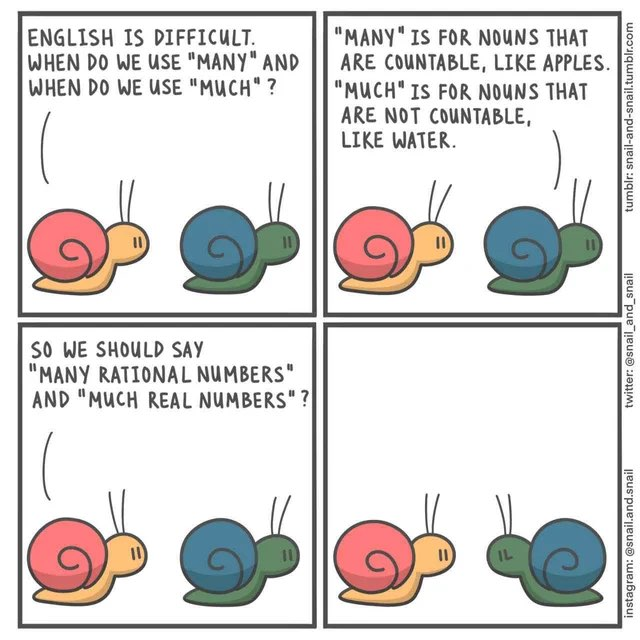
4 Panel comic with 2 snails.Panel 1:
Left snail craws behind right snail and asks: 'English is difficult. When do we use "many" and when do we use "much"?Panel 2:
Right snail answers: '"Many" is for nouns that are countable, like apples. "Much" is for nouns that are not countable, like water.Panel 3:
Left snail concludes: 'So we should say "many rational numbers" and "much real numbers"?Panel 4:
Right snail is turned around to look (with pain?) at left snail. -
@StefanMuelller I think that makes sense!
-
@StefanMuelller
I would say, things where you can identify unique items…. But then electrons..@ThreeSigma @StefanMuelller
Thundercats ? -
@StefanMuelller@lingo.lol But neither real numbers nor (ir)rational numbers are limited?
Probably should have said something like "indefinite" rather than merely "countable"
…and, yes, I get the joke.
Oddly, I tend to far more frequently run into the opposite of this problem ("fewer" versus "less"). -
@StefanMuelller @lexiconista I’m noticing everyone around me (in the Netherlands though, so English as a second language) using “amount” for countable things instead of “number”. Is that a real trend?
@bart @StefanMuelller @lexiconista so much came before many?
-