Book 1: The Hidden Life of Trees.
-
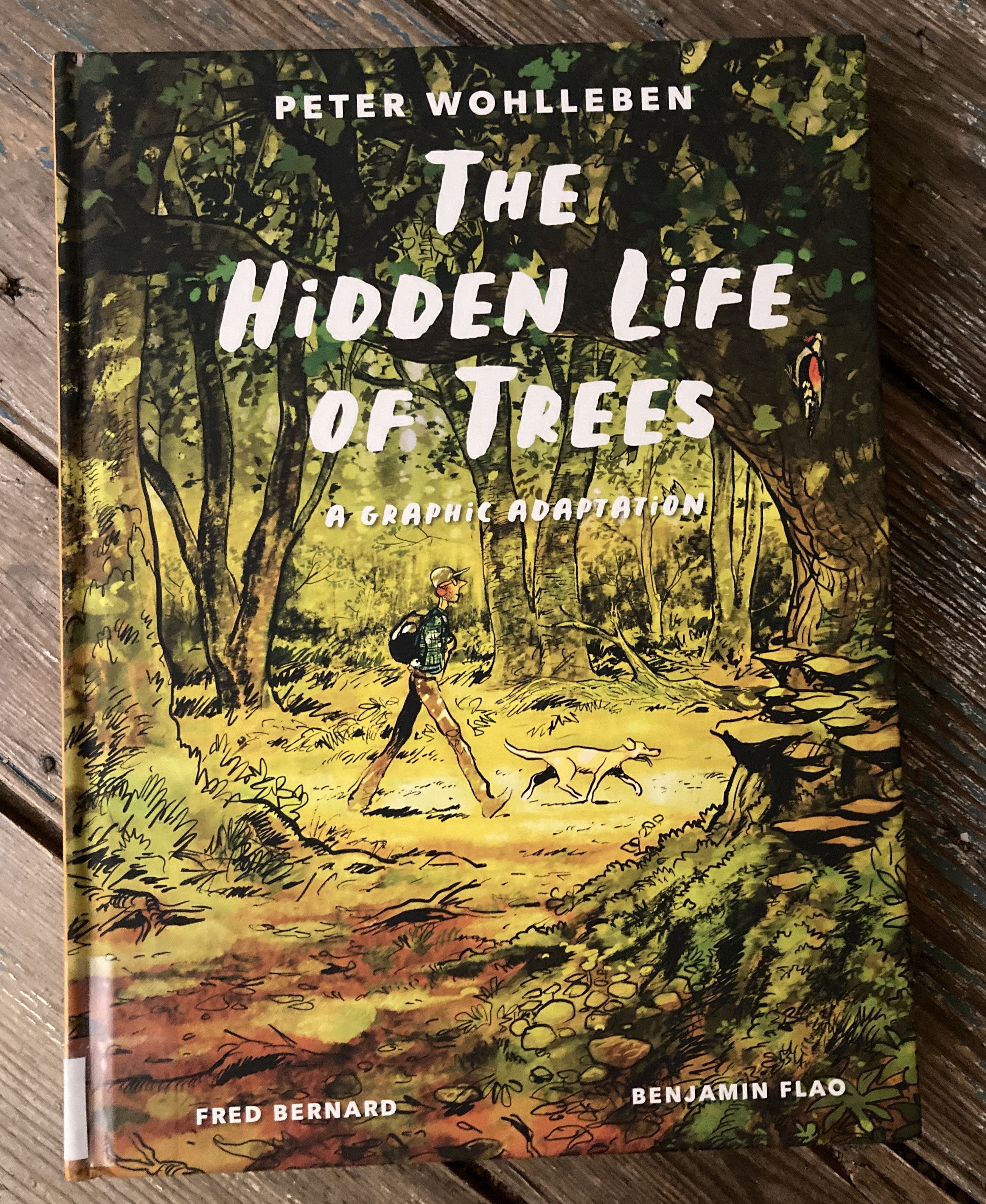
Book 1: The Hidden Life of Trees. I have not read the original book that this is an adaptation of. However, this is a glorious book in and of itself, discussing not just the author's knowledge of trees and forest ecosystems, but his path through finding a way to find meaningful work studying and promoting these things. The adaptation is masterful, the drawing, lettering, and coloring all add to the final product, itself printed on sustainably forested paper.
Book 2: The Lantern Men. Another one in this series with a slightly confusing cast of whodunit characters, a bike race, and some local lore at the center of it. This particular book took a big jump in a few plot points, mainly in good ways but some in less-plausible-feeling ways. Feels a bit like the author is trying to readjust some story arcs to wrap it all up which it does a few books from now. I enjoyed getting to see the same folks again, but not my fave of the mysteries.
-
Book 2: The Lantern Men. Another one in this series with a slightly confusing cast of whodunit characters, a bike race, and some local lore at the center of it. This particular book took a big jump in a few plot points, mainly in good ways but some in less-plausible-feeling ways. Feels a bit like the author is trying to readjust some story arcs to wrap it all up which it does a few books from now. I enjoyed getting to see the same folks again, but not my fave of the mysteries.
Book 3: Family Style. A graphic novel memoir about the author's journey to the US starting as a Vietnamese refugee coming to Thailand on a boat under awful conditions & slowly getting to the US and eventually becoming the graphic novelist and cartoonist that he is today. It's told in chapters each of which has a different food (some Vietnamese and some very much not) as a framing device. It's really interesting getting to see the refugee experience through the eyes of a child. A well told story.
-
Book 3: Family Style. A graphic novel memoir about the author's journey to the US starting as a Vietnamese refugee coming to Thailand on a boat under awful conditions & slowly getting to the US and eventually becoming the graphic novelist and cartoonist that he is today. It's told in chapters each of which has a different food (some Vietnamese and some very much not) as a framing device. It's really interesting getting to see the refugee experience through the eyes of a child. A well told story.
Book 4: Providence. I've liked Barry's other books and I liked this one in a different way. It's a straight up long-haul forever-war sort of story about a crew of four flawed people on a four-year tour of deep space with a mission to kill a seemingly endless supply of one type of alien creatures. Oh and their ship is run by an AI so sophisticated that the humans are really only there for PR purposes, and maybe to help the AI company sell more AI. Written in 2020 but still feels fresh.
-
Book 4: Providence. I've liked Barry's other books and I liked this one in a different way. It's a straight up long-haul forever-war sort of story about a crew of four flawed people on a four-year tour of deep space with a mission to kill a seemingly endless supply of one type of alien creatures. Oh and their ship is run by an AI so sophisticated that the humans are really only there for PR purposes, and maybe to help the AI company sell more AI. Written in 2020 but still feels fresh.
-
-
-
@jessamyn @puffer I feel like this author has a little trouble sticking the landing. I felt that way after Lexicon as well. He even congratulates himself in the Afterward that he learned to “fire the gun,” but he very distinctly did not fire the gun in question. He implied it maybe, but there’s the possibility that some other ship came in and fired their gun.
Apart from that, I felt pretty sure from the start that everything was going to go wrong. And that part was satisfying just from a pure storytelling point of view. I think it may have been better yet, though, if Beanfield didn’t survive, the ship did destroy her (and we saw the gun fire) and the ending is more about how they got the intel off the planet and that’s how they won.
But overall, I enjoyed the read. I’ll probably read more by the author eventually.
What did you think?
-
@jessamyn @puffer I feel like this author has a little trouble sticking the landing. I felt that way after Lexicon as well. He even congratulates himself in the Afterward that he learned to “fire the gun,” but he very distinctly did not fire the gun in question. He implied it maybe, but there’s the possibility that some other ship came in and fired their gun.
Apart from that, I felt pretty sure from the start that everything was going to go wrong. And that part was satisfying just from a pure storytelling point of view. I think it may have been better yet, though, if Beanfield didn’t survive, the ship did destroy her (and we saw the gun fire) and the ending is more about how they got the intel off the planet and that’s how they won.
But overall, I enjoyed the read. I’ll probably read more by the author eventually.
What did you think?
@RyanHyde @puffer I started to despair that there would be anything but an "everyone dies" ending once they crashed on the planet. Like, I appreciate an author who is willing to kill off 75% of their characters, but also was like "You get that far into doing some first contact communication stuff and then wrap it up like that?"
Gilly confused me as a character even though I probably identified the most with him. I read a lot of reviews just so that I could...
-
@RyanHyde @puffer I started to despair that there would be anything but an "everyone dies" ending once they crashed on the planet. Like, I appreciate an author who is willing to kill off 75% of their characters, but also was like "You get that far into doing some first contact communication stuff and then wrap it up like that?"
Gilly confused me as a character even though I probably identified the most with him. I read a lot of reviews just so that I could...
@RyanHyde @puffer be sure about what I'd read and none of them really discussed the ending because spoilers. So we're left to fill in some blanks and I agree with you "How we got the intel" would have been a good story. I feel if all your characters are, at some level, unlikable, you have to have some other positive or interesting payoff. I did not see that here and having read Tchaikovsky's "Shroud" a while back, this was not as good.
-
@RyanHyde @puffer be sure about what I'd read and none of them really discussed the ending because spoilers. So we're left to fill in some blanks and I agree with you "How we got the intel" would have been a good story. I feel if all your characters are, at some level, unlikable, you have to have some other positive or interesting payoff. I did not see that here and having read Tchaikovsky's "Shroud" a while back, this was not as good.
@jessamyn @puffer Anders is the one who confused me the most. There was just something so incongruous about his trauma response and how it informed his decision making. I mean, I think that’s by design to make him unsettling, but he made a pretty unconvincing hero at the end. Again, maybe the point.
But yes, they’re all unlikable. And so is the vision of humanity presented (which was a pretty naked commentary on the unreliability and vapid nature of social media). Again, maybe all of that is the point. The Mak Tek were actual monsters (I did kinda get chills when Martin revealed that they’d killed off two other species), but so was the version of humanity in this novel. They didn’t actually know the salamanders were going for all out genocide before the humans made their own genocidal plan.
Anyway, I’ll add Shroud to my hold list. I’ve been meaning to try Adrian Tchaikovsky out.
-
@jessamyn @puffer Anders is the one who confused me the most. There was just something so incongruous about his trauma response and how it informed his decision making. I mean, I think that’s by design to make him unsettling, but he made a pretty unconvincing hero at the end. Again, maybe the point.
But yes, they’re all unlikable. And so is the vision of humanity presented (which was a pretty naked commentary on the unreliability and vapid nature of social media). Again, maybe all of that is the point. The Mak Tek were actual monsters (I did kinda get chills when Martin revealed that they’d killed off two other species), but so was the version of humanity in this novel. They didn’t actually know the salamanders were going for all out genocide before the humans made their own genocidal plan.
Anyway, I’ll add Shroud to my hold list. I’ve been meaning to try Adrian Tchaikovsky out.
-
Book 4: Providence. I've liked Barry's other books and I liked this one in a different way. It's a straight up long-haul forever-war sort of story about a crew of four flawed people on a four-year tour of deep space with a mission to kill a seemingly endless supply of one type of alien creatures. Oh and their ship is run by an AI so sophisticated that the humans are really only there for PR purposes, and maybe to help the AI company sell more AI. Written in 2020 but still feels fresh.
Book 5: Night Hawks. Another one of the forensic anthropologist mysteries where we again are working towards a thrilling conclusion of the series. This one had a convoluted mystery, a lot of rando characters with similar-sounding names and not a lot of history stuff which is usually my favorite part. And then there's the overarching plot arc which continued in a good way. A nice familiar read but not one of my faves of the series.
-
Book 5: Night Hawks. Another one of the forensic anthropologist mysteries where we again are working towards a thrilling conclusion of the series. This one had a convoluted mystery, a lot of rando characters with similar-sounding names and not a lot of history stuff which is usually my favorite part. And then there's the overarching plot arc which continued in a good way. A nice familiar read but not one of my faves of the series.
Book 6: Tigers Between Empires. An exceptional book about wildlife, specifically tiger, conservation in Siberia and also to a lesser degree in China. Slaght, who also wrote a compelling book about fish owls in the same region, talks about US/Russian cooperation for the Siberian Tiger Project from the early 90s until now. A lot changes, a lot stays the same. Color photos of amazing animals and a lot of nerdy science. You really get to know the place; an excellent geopolitical conservation tale.
-
Book 6: Tigers Between Empires. An exceptional book about wildlife, specifically tiger, conservation in Siberia and also to a lesser degree in China. Slaght, who also wrote a compelling book about fish owls in the same region, talks about US/Russian cooperation for the Siberian Tiger Project from the early 90s until now. A lot changes, a lot stays the same. Color photos of amazing animals and a lot of nerdy science. You really get to know the place; an excellent geopolitical conservation tale.
@jessamyn OMG! Thank you!! I *loved* his Fish-owls book! I am immediately going to find this one!
-
@jessamyn OMG! Thank you!! I *loved* his Fish-owls book! I am immediately going to find this one!
@sunlitrain It's really good. He's not one of the scientists in it, for the most part, so it's a slightly different kind of book but still really good.
-
Book 6: Tigers Between Empires. An exceptional book about wildlife, specifically tiger, conservation in Siberia and also to a lesser degree in China. Slaght, who also wrote a compelling book about fish owls in the same region, talks about US/Russian cooperation for the Siberian Tiger Project from the early 90s until now. A lot changes, a lot stays the same. Color photos of amazing animals and a lot of nerdy science. You really get to know the place; an excellent geopolitical conservation tale.
@jessamyn This looks fantastic. I was just watching a documentary on the Amur tigers the other day. What I would give to be able to go see them. I've got plans this year to see jaguars in the Pantanal and pumas in Patagonia, but I suspect I won't ever get the chance to go see these cats.
-
@jessamyn This looks fantastic. I was just watching a documentary on the Amur tigers the other day. What I would give to be able to go see them. I've got plans this year to see jaguars in the Pantanal and pumas in Patagonia, but I suspect I won't ever get the chance to go see these cats.
@technothrasher it's just 500 pages of tiger facts and lots of interesting fieldwork. It is such a great book.
-
Book 6: Tigers Between Empires. An exceptional book about wildlife, specifically tiger, conservation in Siberia and also to a lesser degree in China. Slaght, who also wrote a compelling book about fish owls in the same region, talks about US/Russian cooperation for the Siberian Tiger Project from the early 90s until now. A lot changes, a lot stays the same. Color photos of amazing animals and a lot of nerdy science. You really get to know the place; an excellent geopolitical conservation tale.
Book 7: The Treasure of the Black Swan. A graphic novel about a shipwreck and the drama trying to figure out who was legally entitled to the treasure. It involves diplomats, lawyers, treasure hunters and US, Peruvian and Spanish jurisdiction. Based on a true story (which I did not read up on until afterwards) it's an interesting and well-told and easy to follow story even though it was clearly a pretty convoluted situation at the time.
-
Book 7: The Treasure of the Black Swan. A graphic novel about a shipwreck and the drama trying to figure out who was legally entitled to the treasure. It involves diplomats, lawyers, treasure hunters and US, Peruvian and Spanish jurisdiction. Based on a true story (which I did not read up on until afterwards) it's an interesting and well-told and easy to follow story even though it was clearly a pretty convoluted situation at the time.
@jessamyn
This sounds neat. Thanks! -
Book 7: The Treasure of the Black Swan. A graphic novel about a shipwreck and the drama trying to figure out who was legally entitled to the treasure. It involves diplomats, lawyers, treasure hunters and US, Peruvian and Spanish jurisdiction. Based on a true story (which I did not read up on until afterwards) it's an interesting and well-told and easy to follow story even though it was clearly a pretty convoluted situation at the time.
I read this a while back and enjoyed it. Have you read any of Paco Roca's other books? His "Memoirs of a Man in Pajamas" is fun.