Skip to content
Abspeckgeflüster – Forum für Menschen mit Gewicht(ung)

Kostenlos. Werbefrei. Menschlich. Dein Abnehmforum.

  • 0 Stimmen
    1 Beiträge
    0 Aufrufe
    mkwadee@mastodon.org.ukM
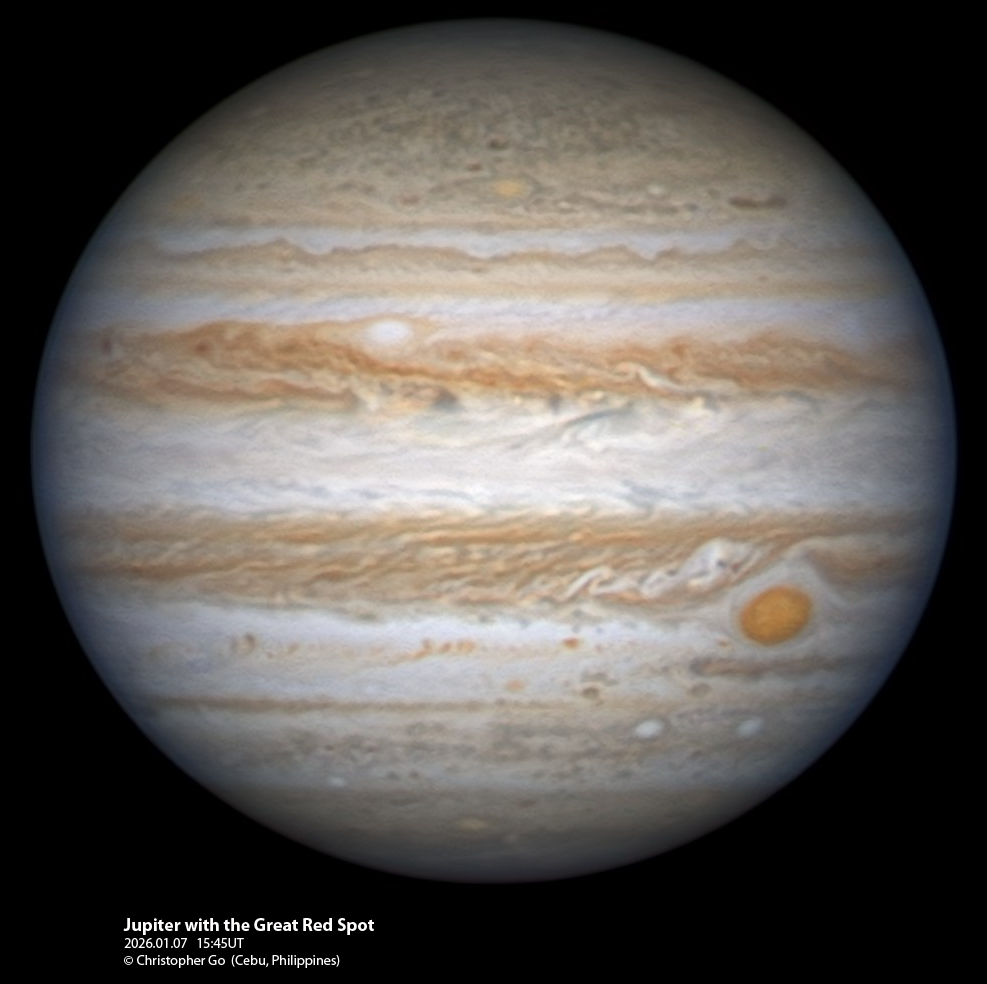
    #Jupiter with the #GreatRedSpot#Astronomy #Picture of the Dayhttps://apod.nasa.gov/apod/ap260110.html#APOD
  • 0 Stimmen
    2 Beiträge
    0 Aufrufe
    crossgolf_rebel@moppels.barC
    @mkwadee@mastodon.org.uk
  • Jupiter's Clouds in High Definition from Juno

    Uncategorized apod
    1
    1
    0 Stimmen
    1 Beiträge
    0 Aufrufe
    apod@reentry.codl.frA
    Jupiter's Clouds in High Definition from JunoImage Credit: NASA/JPL-Caltech/SwRI/MSSS; Processing & License: Thomas ThomopoulosExplanation: How complex is Jupiter? NASA's Juno mission to Jupiter is finding the Jovian giant to be more complicated than expected. Jupiter's magnetic field has been discovered to be much different from our Earth's simple dipole field, showing several poles embedded in a complicated network more convoluted in the north than the south. Further, Juno's radio measurements show that Jupiter's atmosphere shows structure well below the upper cloud deck -- even hundreds of kilometers deep. Jupiter's newfound complexity is evident also in southern clouds, as shown in the texture and color enhanced featured image taken last month. There, planet-circling zones and belts that dominate near the equator decay into a complex miasma of continent-sized storm swirls. Juno continues in its looping elliptical orbit, swooping near the huge planet every month and exploring a slightly different sector each time around.https://apod.nasa.gov/apod/ap260106.html #apod
  • Full Moonlight

    Uncategorized apod
    1
    1
    0 Stimmen
    1 Beiträge
    0 Aufrufe
    apod@reentry.codl.frA
    Full MoonlightImage Credit & Copyright: Zhengjie Wu and Jeff Dai (TWAN)Explanation: The Full Moon is the brightest lunar phase, and tonight you can stand in the light of the first Full Moon of 2026. In fact, the Moon's full phase occurs on January 3 at 10:03 UTC, while only about 7 hours later planet Earth reaches its 2026 perihelion, the closest point in its elliptical orbit around the Sun, at 17:16 UTC. January's Full Moon was also not far from its own perigee, or closest approach to planet Earth. For this lunation the Moon's perigee was on January 1 at 21:44 UTC. You can also spot planet Jupiter, near its brightest for 2026 and close on the sky to the Full Moon tonight, but while you're out skygazing don't forget to look for rare, bright fireballs from the Quadrantid meteor shower.https://apod.nasa.gov/apod/ap260103.html #apod
  • Auroral Corona

    Uncategorized apod
    1
    1
    0 Stimmen
    1 Beiträge
    0 Aufrufe
    apod@reentry.codl.frA
    Auroral CoronaImage Credit & Copyright: Roi LeviExplanation: Cycle 25 solar maximum made 2025 a great year for aurora borealis (or aurora australis) on planet Earth. And the high level of solar activity should extend into 2026. So, while you're celebrating the arrival of the new year, check out this spectacular auroral display that erupted in starry night skies over Kirkjufell, Iceland. The awesome auroral corona, energetic curtains of light streaming from directly overhead, was witnessed during a strong geomagnetic storm triggered by intense solar activity near the March 2025 equinox. This northland and skyscape captures the evocative display in a 21 frame panoramic mosaic.https://apod.nasa.gov/apod/ap260101.html #apod
  • M1: The Crab Nebula

    Uncategorized apod
    1
    1
    0 Stimmen
    1 Beiträge
    0 Aufrufe
    apod@reentry.codl.frA
    M1: The Crab NebulaImage Credit & Copyright: Alan ChenExplanation: This is the mess that is left when a star explodes. The Crab Nebula, the result of a supernova seen in 1054 AD, is filled with mysterious filaments. The filaments are not only tremendously complex but appear to have less mass than expelled in the original supernova and a higher speed than expected from a free explosion. The featured image was taken by an amateur astronomer in Leesburg, Florida, USA over three nights last month. It was captured in three primary colors but with extra detail provided by specific emission by hydrogen gas. The Crab Nebula spans about 10 light years. In the Nebula's very center lies a pulsar: a neutron star as massive as the Sun but with only the size of a small town. The Crab Pulsar rotates about 30 times each second.https://apod.nasa.gov/apod/ap251229.html #apod
  • Jupiter and the Meteors from Gemini

    Uncategorized apod
    1
    1
    0 Stimmen
    1 Beiträge
    0 Aufrufe
    apod@reentry.codl.frA
    Jupiter and the Meteors from GeminiImage Credit & Copyright: David CruzExplanation: Jupiter, the Solar System's ruling gas giant, is the brightest celestial beacon at the center of this composite night skyscape. The scene was constructed by selecting the 40 exposures containing meteors from about 500 exposures made on the nights of December 13 and 14, near peak activity for this year's annual Geminid meteor shower. With each selected exposure registered in the night sky above Alentejo, Portugal, planet Earth, it does look like the meteors are streaming away from Jupiter. But the apparent radiant of the Geminid meteors is actually closer to bright star Castor, in the shower's eponymous constellation Gemini. In this frame that's just a little above and left of the Solar System's most massive planet. Still, the parent body of Geminid meteors is known to be rocky, near-Earth asteroid 3200 Phaethon. And the orbit of Phaethon itself is influenced by the gravitational attraction exerted by massive Jupiter, in concert with planets of the inner Solar System.https://apod.nasa.gov/apod/ap251218.html #apod