Twelve years.
-
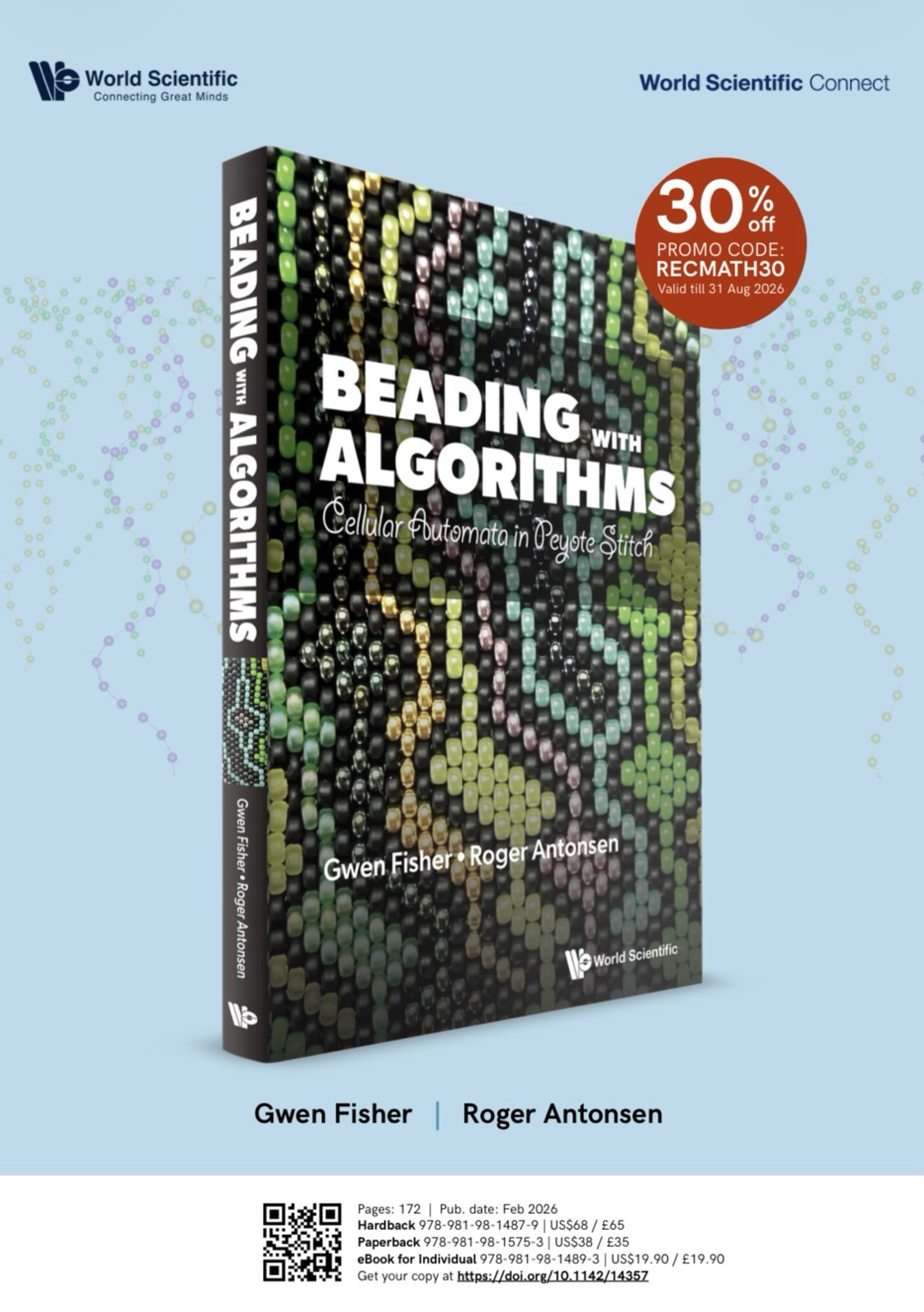
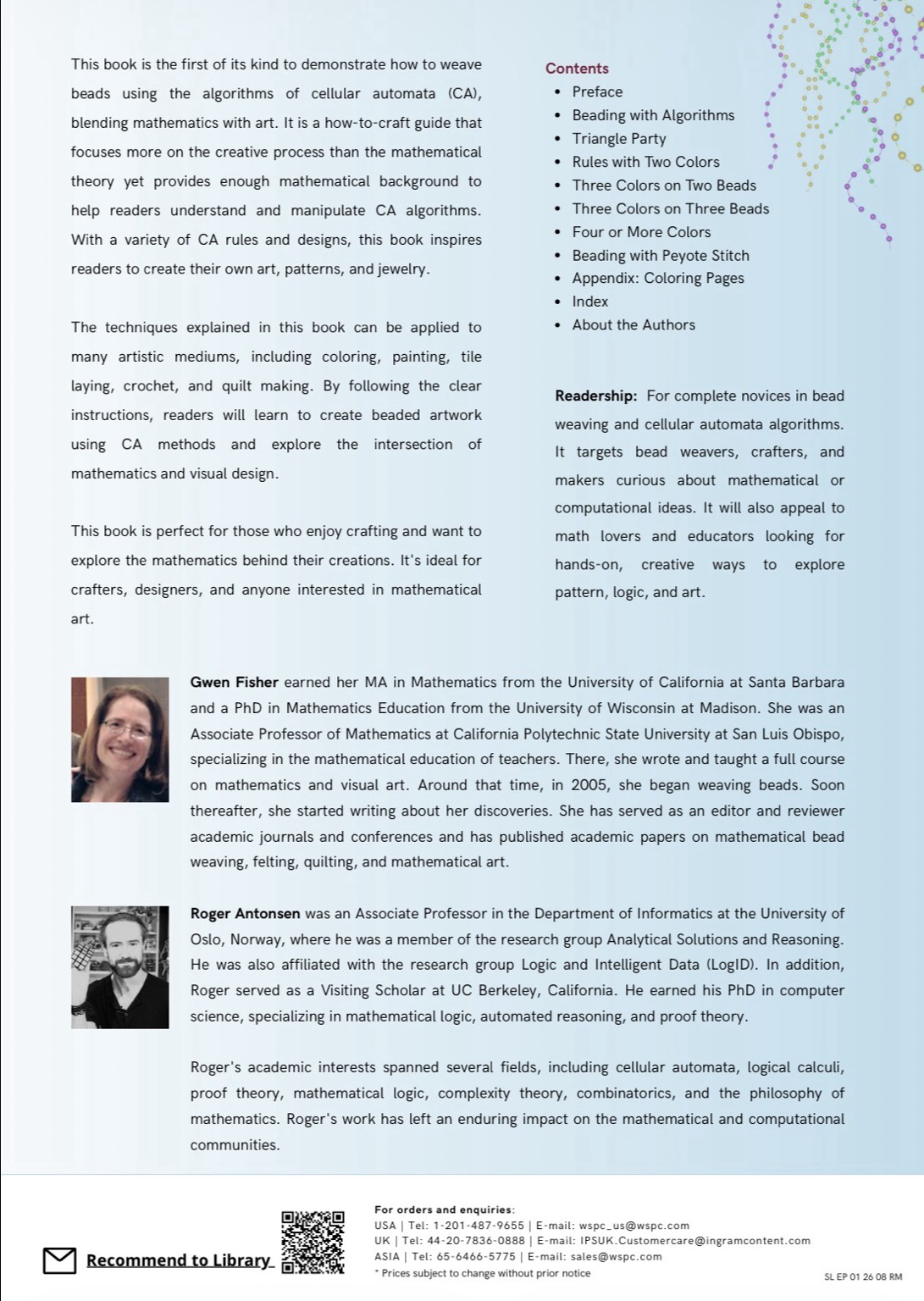
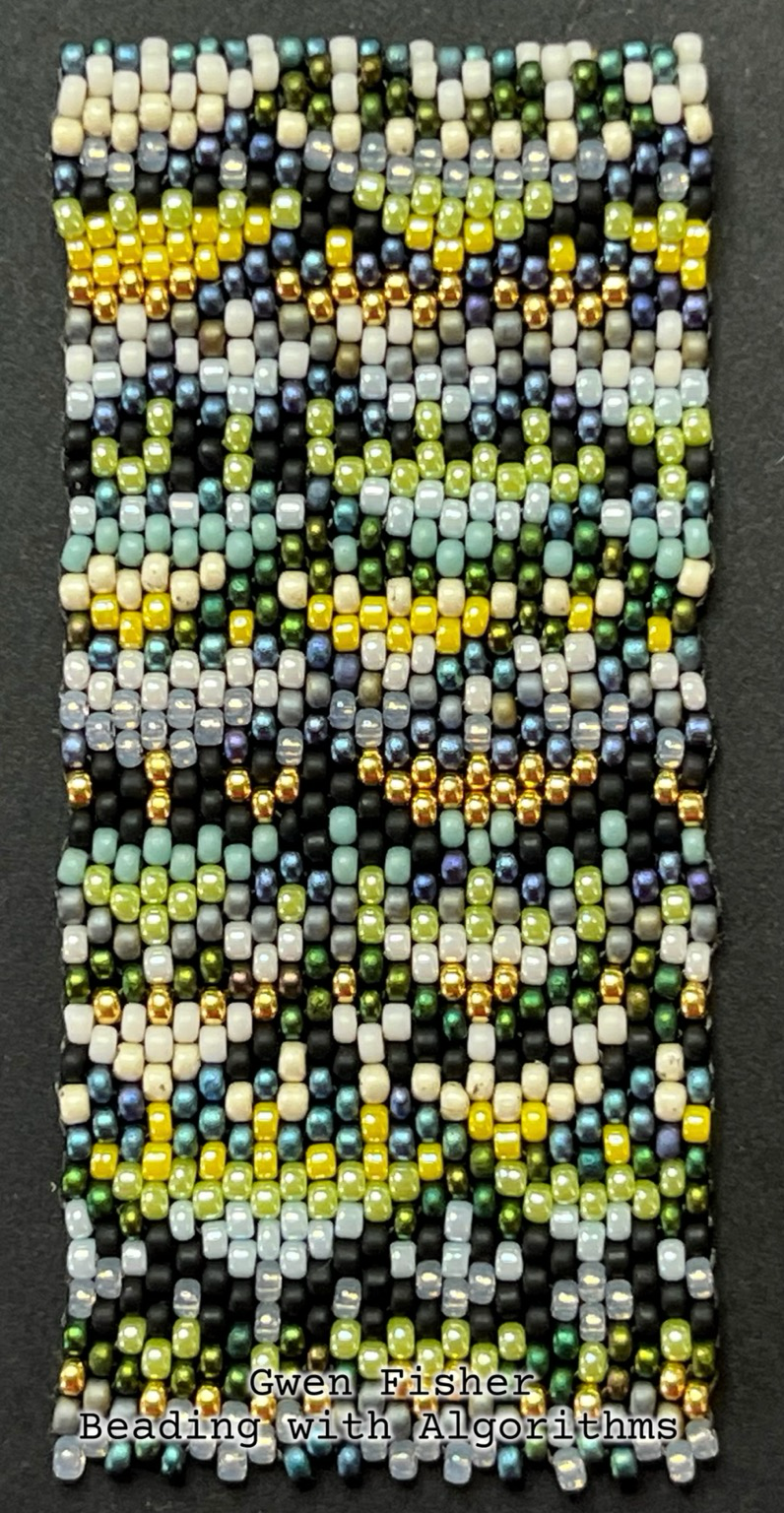
Twelve years. I started this project twelve years ago, and today I hold the result in my hand. It’s a book that combines bead weaving with math called, “Beading with Algorithms: Cellular Automata in Peyote Stitch.” With help from mathematician and artist Roger Antonsen, graphic designer Zelda Lin, a handful of talented proof readers, and the good people from World Scientific Publishing Company, my dream of combining my loves of math, art, and teaching into a book is finally a reality.
This book is the first of its kind, a recipe book of algorithms that can be used and combined to generate colorful patterns in peyote stitch beadwork in any size and shape you desire. These algorithms could also be applied to other pixelated art forms like tile laying, embroidery, crochet, and quilts. We included projects like bracelets, pill pouches, pendants, beaded beads, and key chains. We also included a bunch of different grids that you can photocopy and color with markers.
Of course I’m biased, but I think it’s a really beautiful book. We included multiple colorful images on almost every page, 172 pages in all. It was a huge layout challenge, but Zelda nailed it. My original goal was to write 128 pages on how to use algorithms to make beaded jewelry, but the more we explored the space, the more we found. Not just millions of algorithms, the space of possibilities is infinite. So of course, we couldn’t include them all. But we used math and Roger’s custom software that he wrote for this project to help us find dozens of the easiest algorithms and more than a hundred more in increasing levels of complexity. We included all of our favorites. 1/2
@gwenbeads smukt og fascinerende.
-
Twelve years. I started this project twelve years ago, and today I hold the result in my hand. It’s a book that combines bead weaving with math called, “Beading with Algorithms: Cellular Automata in Peyote Stitch.” With help from mathematician and artist Roger Antonsen, graphic designer Zelda Lin, a handful of talented proof readers, and the good people from World Scientific Publishing Company, my dream of combining my loves of math, art, and teaching into a book is finally a reality.
This book is the first of its kind, a recipe book of algorithms that can be used and combined to generate colorful patterns in peyote stitch beadwork in any size and shape you desire. These algorithms could also be applied to other pixelated art forms like tile laying, embroidery, crochet, and quilts. We included projects like bracelets, pill pouches, pendants, beaded beads, and key chains. We also included a bunch of different grids that you can photocopy and color with markers.
Of course I’m biased, but I think it’s a really beautiful book. We included multiple colorful images on almost every page, 172 pages in all. It was a huge layout challenge, but Zelda nailed it. My original goal was to write 128 pages on how to use algorithms to make beaded jewelry, but the more we explored the space, the more we found. Not just millions of algorithms, the space of possibilities is infinite. So of course, we couldn’t include them all. But we used math and Roger’s custom software that he wrote for this project to help us find dozens of the easiest algorithms and more than a hundred more in increasing levels of complexity. We included all of our favorites. 1/2
@gwenbeads congratulations! It’s giving Gödel, Escher, Bach

-
@gwenbeads congratulations! It’s giving Gödel, Escher, Bach
@cthon1c awe, that is such a sweet comment.
 ️ I’ve tried reading that book a few times and never got to the end. I assure you that the picture to text ratio is much larger in our book. We also have countless tables. So many tables.
 -
We found so much to include that the book ended up a full third longer than I had originally planned. It took years longer than I originally expected. But it was a labor of love, a passion project, something we made because we wanted to make something beautiful and inspiring. I can hardly believe it’s finally finished. I hope you will love it too.
Link to order the book: https://www.worldscientific.com/worldscibooks/10.1142/14357#t=aboutBook
There’s a 30% off code
RECMATH30It’s preorder. The release date is the end of February. 2/2
@gwenbeads pre-ordered, looking forward to it. We just had a family friendship bracelet night last night

-
@gwenbeads pre-ordered, looking forward to it. We just had a family friendship bracelet night last night
@grease thank you very much. I hope you enjoy making art with these algorithms as much as I have. As a family, you can all choose the same algorithm, but each use different colors and a different initial condition, and you’ll all get a different piece of art.
-
We found so much to include that the book ended up a full third longer than I had originally planned. It took years longer than I originally expected. But it was a labor of love, a passion project, something we made because we wanted to make something beautiful and inspiring. I can hardly believe it’s finally finished. I hope you will love it too.
Link to order the book: https://www.worldscientific.com/worldscibooks/10.1142/14357#t=aboutBook
There’s a 30% off code
RECMATH30It’s preorder. The release date is the end of February. 2/2
@gwenbeads will there be an ebook?
Thank you!
-
@grease thank you very much. I hope you enjoy making art with these algorithms as much as I have. As a family, you can all choose the same algorithm, but each use different colors and a different initial condition, and you’ll all get a different piece of art.
@gwenbeads that's so cool. Will def appeal to the kiddos

-
We found so much to include that the book ended up a full third longer than I had originally planned. It took years longer than I originally expected. But it was a labor of love, a passion project, something we made because we wanted to make something beautiful and inspiring. I can hardly believe it’s finally finished. I hope you will love it too.
Link to order the book: https://www.worldscientific.com/worldscibooks/10.1142/14357#t=aboutBook
There’s a 30% off code
RECMATH30It’s preorder. The release date is the end of February. 2/2
@gwenbeads Thank you so much for the notice and discount code! Being an extreme novice in mathematics I am a bit wary but when I read the time and devotion you took to write this...how could one not considering purchasing it. Going to follow #beading and other tags.
 ️
️ -
Twelve years. I started this project twelve years ago, and today I hold the result in my hand. It’s a book that combines bead weaving with math called, “Beading with Algorithms: Cellular Automata in Peyote Stitch.” With help from mathematician and artist Roger Antonsen, graphic designer Zelda Lin, a handful of talented proof readers, and the good people from World Scientific Publishing Company, my dream of combining my loves of math, art, and teaching into a book is finally a reality.
This book is the first of its kind, a recipe book of algorithms that can be used and combined to generate colorful patterns in peyote stitch beadwork in any size and shape you desire. These algorithms could also be applied to other pixelated art forms like tile laying, embroidery, crochet, and quilts. We included projects like bracelets, pill pouches, pendants, beaded beads, and key chains. We also included a bunch of different grids that you can photocopy and color with markers.
Of course I’m biased, but I think it’s a really beautiful book. We included multiple colorful images on almost every page, 172 pages in all. It was a huge layout challenge, but Zelda nailed it. My original goal was to write 128 pages on how to use algorithms to make beaded jewelry, but the more we explored the space, the more we found. Not just millions of algorithms, the space of possibilities is infinite. So of course, we couldn’t include them all. But we used math and Roger’s custom software that he wrote for this project to help us find dozens of the easiest algorithms and more than a hundred more in increasing levels of complexity. We included all of our favorites. 1/2
@gwenbeads WOW-factor! stunning!
-
@grease thank you very much. I hope you enjoy making art with these algorithms as much as I have. As a family, you can all choose the same algorithm, but each use different colors and a different initial condition, and you’ll all get a different piece of art.
@gwenbeads so looking forward to going through the book, and I know a few family members who will enjoy it too.
-
@gwenbeads Thank you so much for the notice and discount code! Being an extreme novice in mathematics I am a bit wary but when I read the time and devotion you took to write this...how could one not considering purchasing it. Going to follow #beading and other tags.
️@tinfoiling thank you! Working on this book became a side hobby. After year 3, it gave me and my friends who worked on it a reason to meet regularly and chat about our progress and other cool math and art stuff.
Unless we sell 100,000 copies, it’s never going to pay for all the time we put in it, and that’s okay. It was fun, beautiful, and content worth sharing with the world. But maybe, just maybe, we’ll sell 100,000 copies. That’s only 1 in every 83,000 people.
-
 A angelacarstensen@mastodon.online shared this topic