Mastodon Skip to content
  • Home
  • Aktuell
  • Tags
  • Über dieses Forum
Einklappen
Grafik mit zwei überlappenden Sprechblasen, eine grün und eine lila.
Abspeckgeflüster – Forum für Menschen mit Gewicht(ung)

Kostenlos. Werbefrei. Menschlich. Dein Abnehmforum.

  1. Home
  2. Uncategorized
  3. When we design for disabilities, we make things better for everyone.

When we design for disabilities, we make things better for everyone.
Geplant Angeheftet Gesperrt Verschoben Uncategorized
48 Beiträge 23 Kommentatoren 0 Aufrufe
  • Älteste zuerst
  • Neuste zuerst
  • Meiste Stimmen
Antworten
  • In einem neuen Thema antworten
Anmelden zum Antworten
Dieses Thema wurde gelöscht. Nur Nutzer mit entsprechenden Rechten können es sehen.
  • stephaniewalter@front-end.socialS stephaniewalter@front-end.social

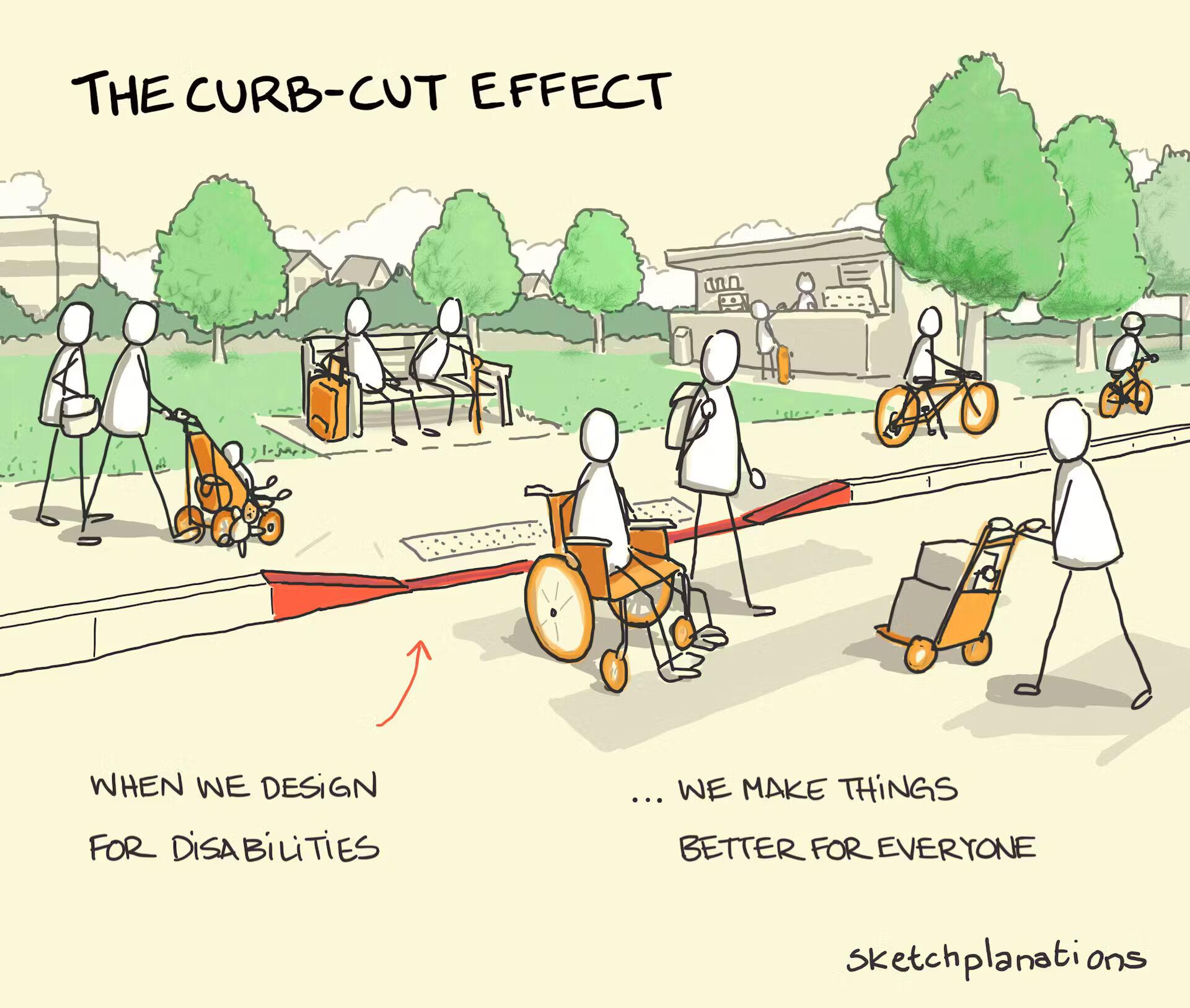
    When we design for disabilities, we make things better for everyone. This is called the Curb-Cut Effect. The term was coined by disability students and activists in the 70s, who added curb cuts to the Berkeley sidewalks to make access easier for those in wheelchairs. They discovered those also helped people with strollers, using trolleys for deliveries, etc.

    anarchy_how@mastodon.greenA This user is from outside of this forum
    anarchy_how@mastodon.greenA This user is from outside of this forum
    anarchy_how@mastodon.green
    schrieb zuletzt editiert von
    #39

    @stephaniewalter

    Thanks for sharing this. Learning from it and sharing. Slowly learning about disABILITY MUNDUS and this seems to be one manifestation of the principle.

    1 Antwort Letzte Antwort
    0
    • stephaniewalter@front-end.socialS stephaniewalter@front-end.social

      A more modern example would be captions in videos: they are a feature designed for deaf and hard of hearing people, but also benefits people with ADHD and auditory processing disorder, people who want to listen to a video without sound for various reasons, etc.

      Illustration by Sketchplanations: https://sketchplanations.com/the-curb-cut-effect

      listrophy@ruby.socialL This user is from outside of this forum
      listrophy@ruby.socialL This user is from outside of this forum
      listrophy@ruby.social
      schrieb zuletzt editiert von
      #40

      @stephaniewalter in my case: parents who don’t want to wake up their young kids because the TV was too loud

      stephaniewalter@front-end.socialS 1 Antwort Letzte Antwort
      0
      • listrophy@ruby.socialL listrophy@ruby.social

        @stephaniewalter in my case: parents who don’t want to wake up their young kids because the TV was too loud

        stephaniewalter@front-end.socialS This user is from outside of this forum
        stephaniewalter@front-end.socialS This user is from outside of this forum
        stephaniewalter@front-end.social
        schrieb zuletzt editiert von
        #41

        @listrophy same here sometimes, making the sound super low to not wake up people in the house

        listrophy@ruby.socialL 1 Antwort Letzte Antwort
        0
        • coreworlder@dice.campC coreworlder@dice.camp

          @stephaniewalter Of you would like more examples then Microsoft has an introduction to inclusive design which has a bunch along those lines which I like.

          https://inclusive.microsoft.design/tools-and-activities/Inclusive101Guidebook.pdf

          This diagram is taken from there.

          johntinker@hear-me.socialJ This user is from outside of this forum
          johntinker@hear-me.socialJ This user is from outside of this forum
          johntinker@hear-me.social
          schrieb zuletzt editiert von
          #42

          @coreworlder @stephaniewalter
          Microsoft likes to claim pieces of the public domain as private property. The first I noticed was the ".doc" file extension as an indication of the file belonging to their proprietary word processor, although it already had an established use in the industry. I hope whoever is making up these drawings is getting paid by Microsoft, and I hope that their chain of command believes that it is a wise business decision to do so. I sincerely hope that nobody else imagines that they will be intelligible to the generic human being. #Microsoft #monopoly #capitalism

          1 Antwort Letzte Antwort
          0
          • stephaniewalter@front-end.socialS stephaniewalter@front-end.social

            @listrophy same here sometimes, making the sound super low to not wake up people in the house

            listrophy@ruby.socialL This user is from outside of this forum
            listrophy@ruby.socialL This user is from outside of this forum
            listrophy@ruby.social
            schrieb zuletzt editiert von
            #43

            @stephaniewalter or really: keeping the TV quiet, so if one kid starts yelling for help (ugh, sure... I'll fix your blanket), I can hear them before they wake up the other kids

            1 Antwort Letzte Antwort
            0
            • johnpettigrew@wandering.shopJ johnpettigrew@wandering.shop

              @stephaniewalter Or the existence of text messages. When mobile phones (cell phones) were first coming into use in the late 80s and early 90s, they were intended for voice calls only. The Deaf community advocate hard for adding text messages to the standards by default. The companies weren't keen, but eventually it was done. And I think we can agree that text messaging turned out to be kind of important to the vast majority of people!

              njsg@mementomori.socialN This user is from outside of this forum
              njsg@mementomori.socialN This user is from outside of this forum
              njsg@mementomori.social
              schrieb zuletzt editiert von
              #44

              @johnpettigrew @stephaniewalter One thing that can get quite annoying: people that insist in commenting that people cannot talk via e.g. IRC or IM just because they're in the same room or next to each other.

              Best case, it may be helping with organization or workflow, or with keeping distractions low. But it can also be preferrable for accessibility.

              1 Antwort Letzte Antwort
              0
              • anemone@ebiverse.socialA anemone@ebiverse.social
                @stephaniewalter@front-end.social raising that part of the road would be even better
                marjolica@social.linux.pizzaM This user is from outside of this forum
                marjolica@social.linux.pizzaM This user is from outside of this forum
                marjolica@social.linux.pizza
                schrieb zuletzt editiert von
                #45

                @anemone @stephaniewalter whatever you do often also has some drawbacks, it's not always a one-way street.
                Dropped curbs also tilt the pavement (US: sidewalk) near the drop so walking or rolling a buggy along them becomes more difficult, likewise for cyclists if they are shared.
                Raised paths across roads create hazards (like speed bumps, sleeping policemen, except they extend to the curb) for vehicles, but in particular for cyclists using the road.

                1 Antwort Letzte Antwort
                0
                • anemone@ebiverse.socialA anemone@ebiverse.social
                  @stephaniewalter@front-end.social raising that part of the road would be even better
                  njsg@mementomori.socialN This user is from outside of this forum
                  njsg@mementomori.socialN This user is from outside of this forum
                  njsg@mementomori.social
                  schrieb zuletzt editiert von
                  #46

                  @anemone @stephaniewalter There's also the problem of keeping the non-road sections level (e.g. sidewalk).

                  If there is insistence in keeping sidewalks raised compared to the rest of the road, what are the best practices to implement this without imposing cant on the sidewalk? Just that (raising the crosswalk part of the road), or are there other ways? (I guess one could also just lower the whole sidewalk, instead of just the edge near the crosswalk?)

                  (Cc:ing @drtcombs in case she is interested?)

                  1 Antwort Letzte Antwort
                  0
                  • stephaniewalter@front-end.socialS stephaniewalter@front-end.social

                    A more modern example would be captions in videos: they are a feature designed for deaf and hard of hearing people, but also benefits people with ADHD and auditory processing disorder, people who want to listen to a video without sound for various reasons, etc.

                    Illustration by Sketchplanations: https://sketchplanations.com/the-curb-cut-effect

                    fbartho@mastodon.socialF This user is from outside of this forum
                    fbartho@mastodon.socialF This user is from outside of this forum
                    fbartho@mastodon.social
                    schrieb zuletzt editiert von
                    #47

                    @stephaniewalter I feel like the migration of things to video is one of those examples of things where capitalism has been damaging accessibility:
                    - Video is less portable, the file-sizes are larger, the algorithms -> I don’t think I know of anyone that has re-homed their published videos.
                    - Video is more painful for the consumer to adapt for accessibility.
                    - Video is harder to ad-block / skip-the-ads
                    - It’s harder to tell if video is BS or too shallow (platform & low-quality sources love this)

                    1 Antwort Letzte Antwort
                    0
                    • stephaniewalter@front-end.socialS stephaniewalter@front-end.social

                      When we design for disabilities, we make things better for everyone. This is called the Curb-Cut Effect. The term was coined by disability students and activists in the 70s, who added curb cuts to the Berkeley sidewalks to make access easier for those in wheelchairs. They discovered those also helped people with strollers, using trolleys for deliveries, etc.

                      jeffgirgenti@theforkiverse.comJ This user is from outside of this forum
                      jeffgirgenti@theforkiverse.comJ This user is from outside of this forum
                      jeffgirgenti@theforkiverse.com
                      schrieb zuletzt editiert von
                      #48

                      @stephaniewalter

                      There's a great 99% Invisible about curb cuts

                      https://99percentinvisible.org/episode/curb-cuts/

                      1 Antwort Letzte Antwort
                      0
                      • energisch_@troet.cafeE energisch_@troet.cafe shared this topic
                      Antworten
                      • In einem neuen Thema antworten
                      Anmelden zum Antworten
                      • Älteste zuerst
                      • Neuste zuerst
                      • Meiste Stimmen


                      Copyright (c) 2025 abSpecktrum (@abspecklog@fedimonster.de)

                      Erstellt mit Schlaflosigkeit, Kaffee, Brokkoli & ♥

                      Impressum | Datenschutzerklärung | Nutzungsbedingungen

                      • Anmelden

                      • Du hast noch kein Konto? Registrieren

                      • Anmelden oder registrieren, um zu suchen
                      • Erster Beitrag
                        Letzter Beitrag
                      0
                      • Home
                      • Aktuell
                      • Tags
                      • Über dieses Forum