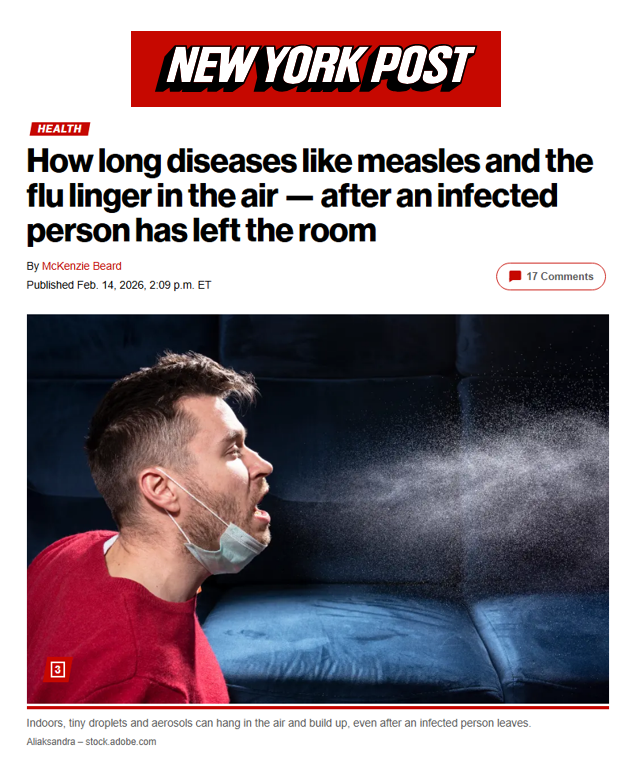
"How long diseases like measles and the flu linger in the air — after an infected person has left the room"
-
"How long diseases like measles and the flu linger in the air — after an infected person has left the room"
RSV: up to 45 mins
Influenza: at least 1 hour
Rhinovirus: 1-2 hours
Measles: up to 2 hours
Norovirus: up to 2 hours
COVID-19: up to 3 hours
Chickenpox: several hours
Mumps: several hours
Tuberculosis (TB): 6-12 hoursSource: https://archive.md/dKnQP
@DenisCOVIDinfoguy Ok but the paper they link does NOT say "up to 3 hours" for COVID-19, it says aerosolized COVID-19 is still highly infectious after 3 hours, when they stopped testing
SARS-CoV-2 remained viable in aerosols throughout the duration of our experiment (3 hours), with a reduction in infectious titer from 103.5 to 102.7 TCID50 per liter of air New England Journal of Medicine
in other words after 3 hours, every single liter of air contained HUNDREDS of particles that could infect.
And in the years since the 2020 study they cite, others have looked at longer time scales, and papers have found that in indoor air > 500 ppm CO2, enough infectious particles effectively persist indefinitely that cleaning the air is the only physically plausible approach: Nature
#COVID19 #COVID #SARSCoV2 #COVIDisAirborne #PublicHealth #pandemic #CovidIsNotOver
-
@DenisCOVIDinfoguy Ok but the paper they link does NOT say "up to 3 hours" for COVID-19, it says aerosolized COVID-19 is still highly infectious after 3 hours, when they stopped testing
SARS-CoV-2 remained viable in aerosols throughout the duration of our experiment (3 hours), with a reduction in infectious titer from 103.5 to 102.7 TCID50 per liter of air New England Journal of Medicine
in other words after 3 hours, every single liter of air contained HUNDREDS of particles that could infect.
And in the years since the 2020 study they cite, others have looked at longer time scales, and papers have found that in indoor air > 500 ppm CO2, enough infectious particles effectively persist indefinitely that cleaning the air is the only physically plausible approach: Nature
#COVID19 #COVID #SARSCoV2 #COVIDisAirborne #PublicHealth #pandemic #CovidIsNotOver
Agree. Three hours would be short. It's going to be a statistical distribution as the virus particles over time are rendered non-viable, with long tail. They probably last a lot longer in the air than we'd care to admit to ourselves. Coronas in experimental rotating drums lasted 48 hours or something. That said, the particles dilute over time, and we need to breathe enough that one particle does end up infecting.
-
Agree. Three hours would be short. It's going to be a statistical distribution as the virus particles over time are rendered non-viable, with long tail. They probably last a lot longer in the air than we'd care to admit to ourselves. Coronas in experimental rotating drums lasted 48 hours or something. That said, the particles dilute over time, and we need to breathe enough that one particle does end up infecting.
@datum I'd only trust any of those studies if done by knowledgeable people (they never are) and with a suitable sample size (they're usually done by ID people and they're embarrassingly bad). Hope the studies that produced these numbers were decent.
-
Agree. Three hours would be short. It's going to be a statistical distribution as the virus particles over time are rendered non-viable, with long tail. They probably last a lot longer in the air than we'd care to admit to ourselves. Coronas in experimental rotating drums lasted 48 hours or something. That said, the particles dilute over time, and we need to breathe enough that one particle does end up infecting.
@jmcrookston @datum I'm trying to understand what all this means, in practical terms, for covid-cautious people who live with people who take no covid precautions. A common concern is removing one's respirator to take a shower in a bathroom that has recently been used by someone who might be infected with SARS-CoV-2. I've been under the impression that there's value in waiting even a short time (15-60 minutes), as the risk will go down, albeit not to zero. Is that incorrect?
-
Agree. Three hours would be short. It's going to be a statistical distribution as the virus particles over time are rendered non-viable, with long tail. They probably last a lot longer in the air than we'd care to admit to ourselves. Coronas in experimental rotating drums lasted 48 hours or something. That said, the particles dilute over time, and we need to breathe enough that one particle does end up infecting.
@jmcrookston Yep. The newer article I linked splits infectivity into phases, and in the final phase volume has decreased to the point that mucin effectively stops evaporation, and SARS-CoV-2 degrades very slowly if there's no UV.
"The particles dilute over time" so long as there's any ACH. I had a discussion here where someone pointed out their shared stairwell has effectively no ventilation, at which point it's deposition rate. Slow!
-
@jmcrookston @datum I'm trying to understand what all this means, in practical terms, for covid-cautious people who live with people who take no covid precautions. A common concern is removing one's respirator to take a shower in a bathroom that has recently been used by someone who might be infected with SARS-CoV-2. I've been under the impression that there's value in waiting even a short time (15-60 minutes), as the risk will go down, albeit not to zero. Is that incorrect?
@Lkdc so I suggest figure 6 from https://www.nature.com/articles/s41467-024-47777-5
Yes, waiting a short time would reduce airborne load.
It would also help to open a window - both for ACH and because lower CO2 speeds viable virus degradation.
The long tail hard to avoid. If the bathroom is ventilated to 3 ACH it's not "the air is completely gone 3x an hour" but "thrice the volume of air in the room is exchanged per hour" and so forth.
If it's a scenario you face, you could consider augmenting whatever ventilation the common bathroom has with UV disinfection, since it's likely much easier to plug in an emitter than to upgrade ventilation.
I believe there's a correlation between inoculum dose and negative outcomes.
So yes I would understand waiting until the first two phases are expected to pass if possible (their durations can be estimated from that paper and checking humidity (RH) and CO2), and then ACH or UV sterilization to bring down the long tail until it's within your risk budget.
-
@jmcrookston @datum I'm trying to understand what all this means, in practical terms, for covid-cautious people who live with people who take no covid precautions. A common concern is removing one's respirator to take a shower in a bathroom that has recently been used by someone who might be infected with SARS-CoV-2. I've been under the impression that there's value in waiting even a short time (15-60 minutes), as the risk will go down, albeit not to zero. Is that incorrect?
@Lkdc Also a thought experiment:
there is a point at which a person, infected with SARS2, hasn't yet exhaled an infectious particle.
And so there is a point at which they're still are producing very few per exhalation.
Then at the other extreme are superspreaders, putting thousands of infectious particles into the air per exhalation.
While some degrees of defense (waiting 15-60 minutes) are unlikely to be reliable against the latter, they could well bring the former down to astronomical odds of transmission.
So maybe the most honest answer is "whether waiting 15-60 minutes is enough to prevent infection varies, but it will only ever help."
-
@Lkdc so I suggest figure 6 from https://www.nature.com/articles/s41467-024-47777-5
Yes, waiting a short time would reduce airborne load.
It would also help to open a window - both for ACH and because lower CO2 speeds viable virus degradation.
The long tail hard to avoid. If the bathroom is ventilated to 3 ACH it's not "the air is completely gone 3x an hour" but "thrice the volume of air in the room is exchanged per hour" and so forth.
If it's a scenario you face, you could consider augmenting whatever ventilation the common bathroom has with UV disinfection, since it's likely much easier to plug in an emitter than to upgrade ventilation.
I believe there's a correlation between inoculum dose and negative outcomes.
So yes I would understand waiting until the first two phases are expected to pass if possible (their durations can be estimated from that paper and checking humidity (RH) and CO2), and then ACH or UV sterilization to bring down the long tail until it's within your risk budget.
@datum Thank you very much for the detailed assessment.
-
 E energisch_@troet.cafe shared this topic
-
@jmcrookston Yep. The newer article I linked splits infectivity into phases, and in the final phase volume has decreased to the point that mucin effectively stops evaporation, and SARS-CoV-2 degrades very slowly if there's no UV.
"The particles dilute over time" so long as there's any ACH. I had a discussion here where someone pointed out their shared stairwell has effectively no ventilation, at which point it's deposition rate. Slow!
@datum yes if ventilation I meant. Which can be slow or fast of course. If nothing then yes it's agglutination (I understand the particles tend toward certain sizes) and deposition on walls and ceiling and floor. Like cigarette smoke. Should hang out for a long while.
If people want to know how long they can just burn some toast on a pan. Then they can tell us how long that smoke hangs out
If they really want to be bright, they could run their air purifier and see how quickly it clears the air
-
@DenisCOVIDinfoguy Ok but the paper they link does NOT say "up to 3 hours" for COVID-19, it says aerosolized COVID-19 is still highly infectious after 3 hours, when they stopped testing
SARS-CoV-2 remained viable in aerosols throughout the duration of our experiment (3 hours), with a reduction in infectious titer from 103.5 to 102.7 TCID50 per liter of air New England Journal of Medicine
in other words after 3 hours, every single liter of air contained HUNDREDS of particles that could infect.
And in the years since the 2020 study they cite, others have looked at longer time scales, and papers have found that in indoor air > 500 ppm CO2, enough infectious particles effectively persist indefinitely that cleaning the air is the only physically plausible approach: Nature
#COVID19 #COVID #SARSCoV2 #COVIDisAirborne #PublicHealth #pandemic #CovidIsNotOver
@datum I would like to hear some information about how contagious this virus is outdoors playing sports with people.
I've had to give up five years of pickelball becasue of this virus.

-
@Lkdc so I suggest figure 6 from https://www.nature.com/articles/s41467-024-47777-5
Yes, waiting a short time would reduce airborne load.
It would also help to open a window - both for ACH and because lower CO2 speeds viable virus degradation.
The long tail hard to avoid. If the bathroom is ventilated to 3 ACH it's not "the air is completely gone 3x an hour" but "thrice the volume of air in the room is exchanged per hour" and so forth.
If it's a scenario you face, you could consider augmenting whatever ventilation the common bathroom has with UV disinfection, since it's likely much easier to plug in an emitter than to upgrade ventilation.
I believe there's a correlation between inoculum dose and negative outcomes.
So yes I would understand waiting until the first two phases are expected to pass if possible (their durations can be estimated from that paper and checking humidity (RH) and CO2), and then ACH or UV sterilization to bring down the long tail until it's within your risk budget.
As an easy approximation, I would say run the ceiling fan if you have one, or put a fan in the window, and run it until the air doesn't seem steamy to you anymore, the mirror is not steamed up, etc.
Then you can figure the air has been changed
This will probably take 30-45 minutes
Also, I keep my mask on when taking a bath. So that's an option, if you have a tub
-
"How long diseases like measles and the flu linger in the air — after an infected person has left the room"
RSV: up to 45 mins
Influenza: at least 1 hour
Rhinovirus: 1-2 hours
Measles: up to 2 hours
Norovirus: up to 2 hours
COVID-19: up to 3 hours
Chickenpox: several hours
Mumps: several hours
Tuberculosis (TB): 6-12 hoursSource: https://archive.md/dKnQP
From my own no-covid experience since this started, wearing a kn-95 mask as fit tested at all times is good enough. If someone sneezes or coughs in the room, absolutely keep that mask on.
-
@datum I would like to hear some information about how contagious this virus is outdoors playing sports with people.
I've had to give up five years of pickelball becasue of this virus.
The only two times I've caught symptomatic covid, I was outdoors, socially distanced, and wearing an n95. But the other person wasn't
So I wouldn't play pickleball with unmasked people
-
@DenisCOVIDinfoguy
A handy reference - thank you! That tuberculosis is a real outlier - I’m reading about some resurgence in the US, not good. ️
️Problem is, it's not an outlier. People are posting links to papers, in the thread. Covid is never gone, until fresh air has replaced all the air in the room. Certainly not gone in 3 hours
This also makes me question all the other numbers
-
"How long diseases like measles and the flu linger in the air — after an infected person has left the room"
RSV: up to 45 mins
Influenza: at least 1 hour
Rhinovirus: 1-2 hours
Measles: up to 2 hours
Norovirus: up to 2 hours
COVID-19: up to 3 hours
Chickenpox: several hours
Mumps: several hours
Tuberculosis (TB): 6-12 hoursSource: https://archive.md/dKnQP
@DenisCOVIDinfoguy Although I think these times are true, when did it start that the fake news post is cited as credible. The only tell the truth once to tell people lies about ten or hundred other facts.
-
@DenisCOVIDinfoguy »[…] and build up indoors even after an infected person leaves.«
 Build up? How can they, the viruses at least, “build up”?
@ojelabii @DenisCOVIDinfoguy I'm assuming that subheading is New York Post BS clickbait
-
"How long diseases like measles and the flu linger in the air — after an infected person has left the room"
RSV: up to 45 mins
Influenza: at least 1 hour
Rhinovirus: 1-2 hours
Measles: up to 2 hours
Norovirus: up to 2 hours
COVID-19: up to 3 hours
Chickenpox: several hours
Mumps: several hours
Tuberculosis (TB): 6-12 hoursSource: https://archive.md/dKnQP
@DenisCOVIDinfoguy For those outside of the USA, NY Post is a rag. A provocative tabloid that almost always runs right-wing garbage. I'm amazed this story got published, but take its conclusions with heavy salt.
-
@Lkdc so I suggest figure 6 from https://www.nature.com/articles/s41467-024-47777-5
Yes, waiting a short time would reduce airborne load.
It would also help to open a window - both for ACH and because lower CO2 speeds viable virus degradation.
The long tail hard to avoid. If the bathroom is ventilated to 3 ACH it's not "the air is completely gone 3x an hour" but "thrice the volume of air in the room is exchanged per hour" and so forth.
If it's a scenario you face, you could consider augmenting whatever ventilation the common bathroom has with UV disinfection, since it's likely much easier to plug in an emitter than to upgrade ventilation.
I believe there's a correlation between inoculum dose and negative outcomes.
So yes I would understand waiting until the first two phases are expected to pass if possible (their durations can be estimated from that paper and checking humidity (RH) and CO2), and then ACH or UV sterilization to bring down the long tail until it's within your risk budget.
@datum @Lkdc Yes, as much fresh airflow and time as you can give it is good. It will pretty much always help to wait as long as you're able.
Also, if you can arrange a setup to wash just your face in a lower risk environment, like outdoors with a bowl of water or something, then you can shower with a respirator on. It's not anyone's first choice, but for the couple weeks while the other person is sick, it can be a reasonable precaution. Here's some testing with 3M Auras:
https://xcancel.com/AdvancedTweaker/status/1815930182064300274 -
@datum @Lkdc Yes, as much fresh airflow and time as you can give it is good. It will pretty much always help to wait as long as you're able.
Also, if you can arrange a setup to wash just your face in a lower risk environment, like outdoors with a bowl of water or something, then you can shower with a respirator on. It's not anyone's first choice, but for the couple weeks while the other person is sick, it can be a reasonable precaution. Here's some testing with 3M Auras:
https://xcancel.com/AdvancedTweaker/status/1815930182064300274@datum @Lkdc Conveniently, the fluid-resistant 3M Aura 1870+
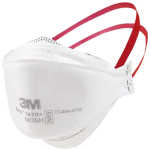 is available by the ~440ct case for only $50:
https://amazon.com/dp/B0937JGMY7So, you can go with a combination of giving the bathroom time to air out plus wearing a respirator to reduce the risk even further.
(Not all respirators are likely to hold up quite as well as the 3M Auras did, so you shouldn't assume that this testing applies perfectly to all other models. However, many quality models should still function ok when damp.)
-
@jmcrookston @datum I'm trying to understand what all this means, in practical terms, for covid-cautious people who live with people who take no covid precautions. A common concern is removing one's respirator to take a shower in a bathroom that has recently been used by someone who might be infected with SARS-CoV-2. I've been under the impression that there's value in waiting even a short time (15-60 minutes), as the risk will go down, albeit not to zero. Is that incorrect?
@Lkdc @jmcrookston @datum Also, the probably blazingly obvious, ensure everyone knows to lower the toilet lid when flushing. You'd THINK, but I once found out someone I knew was *raising* it to flush because they regarded it as some kind of chair back, and by lowering it while flushing, it got icky… so you never know.
Having lived mostly in apartments without bathroom windows, after some minutes of any combination of window and/or exhaust fan ventilation, I'd also consider running a CR box in there for a few minutes ahead of showers. Agitating the air seems like a reasonable way of helping eliminate the total amount of unfiltered air, e.g. spilling out of upward-cupped light fixtures when the temperature rises.