Mastodon Skip to content
  • Home
  • Aktuell
  • Tags
  • Über dieses Forum
Einklappen
Grafik mit zwei überlappenden Sprechblasen, eine grün und eine lila.
Abspeckgeflüster – Forum für Menschen mit Gewicht(ung)

Kostenlos. Werbefrei. Menschlich. Dein Abnehmforum.

  1. Home
  2. Uncategorized
  3. When we design for disabilities, we make things better for everyone.

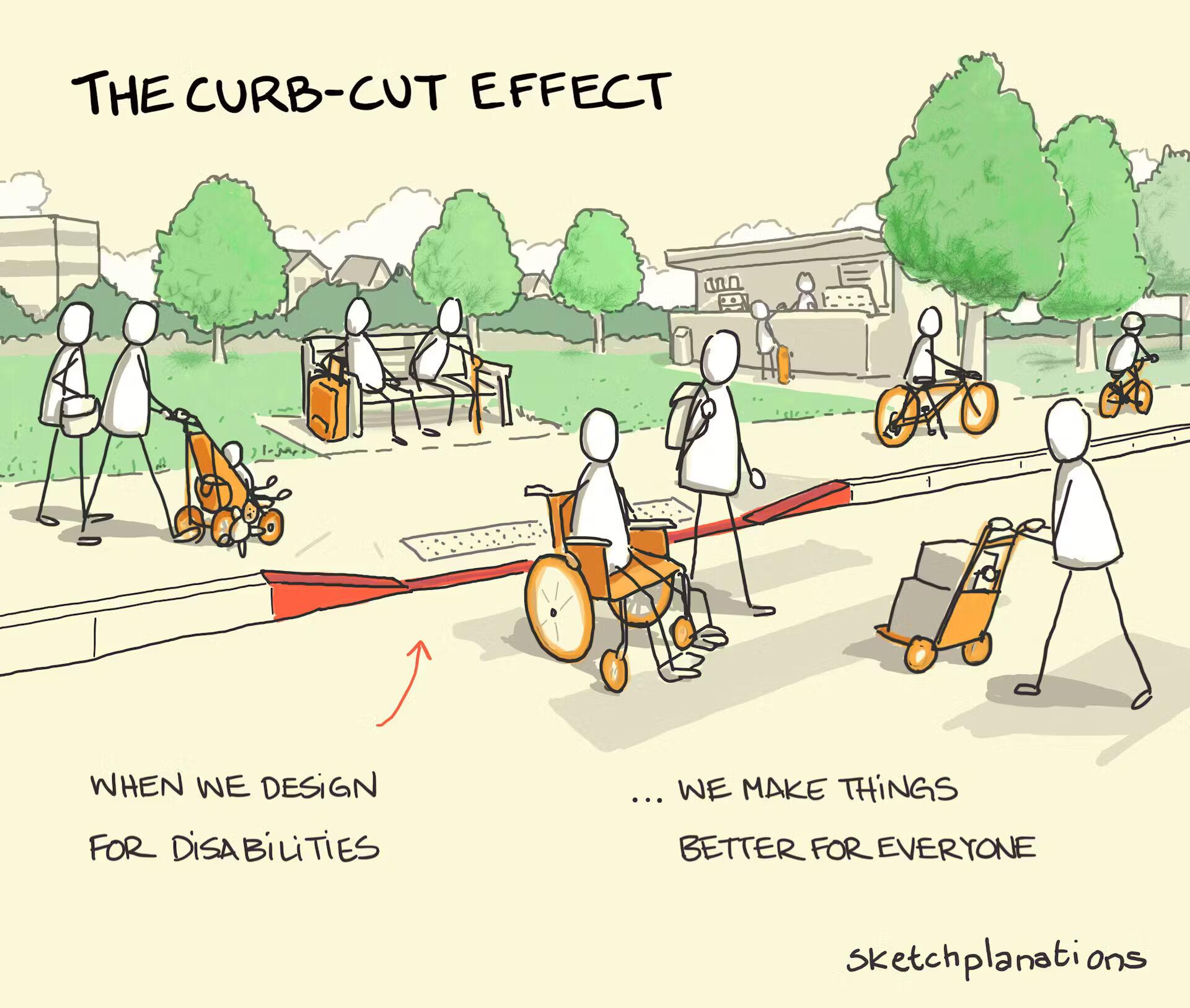
When we design for disabilities, we make things better for everyone.
Geplant Angeheftet Gesperrt Verschoben Uncategorized
48 Beiträge 23 Kommentatoren 0 Aufrufe
  • Älteste zuerst
  • Neuste zuerst
  • Meiste Stimmen
Antworten
  • In einem neuen Thema antworten
Anmelden zum Antworten
Dieses Thema wurde gelöscht. Nur Nutzer mit entsprechenden Rechten können es sehen.
  • stephaniewalter@front-end.socialS stephaniewalter@front-end.social

    A more modern example would be captions in videos: they are a feature designed for deaf and hard of hearing people, but also benefits people with ADHD and auditory processing disorder, people who want to listen to a video without sound for various reasons, etc.

    Illustration by Sketchplanations: https://sketchplanations.com/the-curb-cut-effect

    daniel@mstdn.degu.clD This user is from outside of this forum
    daniel@mstdn.degu.clD This user is from outside of this forum
    daniel@mstdn.degu.cl
    schrieb am zuletzt editiert von
    #3

    @stephaniewalter This is an excellent explanation! The same applies to many things. For example, making the Web more accessible not only helps people with some disabilities but all the people.

    1 Antwort Letzte Antwort
    0
    • stephaniewalter@front-end.socialS stephaniewalter@front-end.social

      When we design for disabilities, we make things better for everyone. This is called the Curb-Cut Effect. The term was coined by disability students and activists in the 70s, who added curb cuts to the Berkeley sidewalks to make access easier for those in wheelchairs. They discovered those also helped people with strollers, using trolleys for deliveries, etc.

      mitsunee@mk.absturztau.beM This user is from outside of this forum
      mitsunee@mk.absturztau.beM This user is from outside of this forum
      mitsunee@mk.absturztau.be
      schrieb am zuletzt editiert von
      #4

      @stephaniewalter@front-end.social the perfect microcosm of what I love about accessibility when it's done right ​​

      1 Antwort Letzte Antwort
      0
      • stephaniewalter@front-end.socialS stephaniewalter@front-end.social

        When we design for disabilities, we make things better for everyone. This is called the Curb-Cut Effect. The term was coined by disability students and activists in the 70s, who added curb cuts to the Berkeley sidewalks to make access easier for those in wheelchairs. They discovered those also helped people with strollers, using trolleys for deliveries, etc.

        electropict@mastodon.scotE This user is from outside of this forum
        electropict@mastodon.scotE This user is from outside of this forum
        electropict@mastodon.scot
        schrieb am zuletzt editiert von
        #5

        @stephaniewalter

        Similarly when we adhere to the principles of human rights and rules based international order we do not merely help people currently living under tyranny; we prevent its spread.

        1 Antwort Letzte Antwort
        0
        • stephaniewalter@front-end.socialS stephaniewalter@front-end.social

          When we design for disabilities, we make things better for everyone. This is called the Curb-Cut Effect. The term was coined by disability students and activists in the 70s, who added curb cuts to the Berkeley sidewalks to make access easier for those in wheelchairs. They discovered those also helped people with strollers, using trolleys for deliveries, etc.

          shininghero@cyberfurz.socialS This user is from outside of this forum
          shininghero@cyberfurz.socialS This user is from outside of this forum
          shininghero@cyberfurz.social
          schrieb am zuletzt editiert von
          #6

          @stephaniewalter Another method I've read about is to raise the entire crossing section to sidewalk height. This is commonly done in the Netherlands as a traffic calming measure, as it acts as a speedbump too.
          Sadly I don't think we'll ever see that in the states.

          bigpawedbear@masto.nuB raphaelmorgan@disabled.socialR 2 Antworten Letzte Antwort
          0
          • stephaniewalter@front-end.socialS stephaniewalter@front-end.social

            When we design for disabilities, we make things better for everyone. This is called the Curb-Cut Effect. The term was coined by disability students and activists in the 70s, who added curb cuts to the Berkeley sidewalks to make access easier for those in wheelchairs. They discovered those also helped people with strollers, using trolleys for deliveries, etc.

            pictor@ohai.socialP This user is from outside of this forum
            pictor@ohai.socialP This user is from outside of this forum
            pictor@ohai.social
            schrieb am zuletzt editiert von
            #7

            @stephaniewalter better would be for the cross walk to be at sidewalk level, turning it into a speed bump for cross traffic.

            richrarobi@mastodon.socialR 1 Antwort Letzte Antwort
            0
            • hatnix@social.tchncs.deH hatnix@social.tchncs.de shared this topic on
            • shininghero@cyberfurz.socialS shininghero@cyberfurz.social

              @stephaniewalter Another method I've read about is to raise the entire crossing section to sidewalk height. This is commonly done in the Netherlands as a traffic calming measure, as it acts as a speedbump too.
              Sadly I don't think we'll ever see that in the states.

              bigpawedbear@masto.nuB This user is from outside of this forum
              bigpawedbear@masto.nuB This user is from outside of this forum
              bigpawedbear@masto.nu
              schrieb am zuletzt editiert von
              #8

              @shininghero @stephaniewalter we have this sort of idea at my local railway station, the final crossing from the street to the station is on a hump in the road.

              1 Antwort Letzte Antwort
              0
              • stephaniewalter@front-end.socialS stephaniewalter@front-end.social

                When we design for disabilities, we make things better for everyone. This is called the Curb-Cut Effect. The term was coined by disability students and activists in the 70s, who added curb cuts to the Berkeley sidewalks to make access easier for those in wheelchairs. They discovered those also helped people with strollers, using trolleys for deliveries, etc.

                koneko@toot.beep.computerK This user is from outside of this forum
                koneko@toot.beep.computerK This user is from outside of this forum
                koneko@toot.beep.computer
                schrieb am zuletzt editiert von
                #9

                @stephaniewalter fixed

                stephaniewalter@front-end.socialS vosje62@mastodon.nlV 2 Antworten Letzte Antwort
                0
                • stephaniewalter@front-end.socialS stephaniewalter@front-end.social

                  When we design for disabilities, we make things better for everyone. This is called the Curb-Cut Effect. The term was coined by disability students and activists in the 70s, who added curb cuts to the Berkeley sidewalks to make access easier for those in wheelchairs. They discovered those also helped people with strollers, using trolleys for deliveries, etc.

                  vick21@mastodon.socialV This user is from outside of this forum
                  vick21@mastodon.socialV This user is from outside of this forum
                  vick21@mastodon.social
                  schrieb am zuletzt editiert von
                  #10

                  @stephaniewalter @FreakyFwoof I love that analogy, but I think it has its problems. Namely that people without disabilities have options even when the curb cut is non-existent. Humans tend to act and take things seriously when they are out of options. Of course, I realize this is quite a generalization, but I am not sure I can do better on social media! 🙂

                  raphaelmorgan@disabled.socialR 1 Antwort Letzte Antwort
                  0
                  • stephaniewalter@front-end.socialS stephaniewalter@front-end.social

                    When we design for disabilities, we make things better for everyone. This is called the Curb-Cut Effect. The term was coined by disability students and activists in the 70s, who added curb cuts to the Berkeley sidewalks to make access easier for those in wheelchairs. They discovered those also helped people with strollers, using trolleys for deliveries, etc.

                    forse@kolektiva.socialF This user is from outside of this forum
                    forse@kolektiva.socialF This user is from outside of this forum
                    forse@kolektiva.social
                    schrieb am zuletzt editiert von
                    #11

                    @stephaniewalter IT HAS A NAME!!! O_O

                    Now I know, thank you! ^_^

                    1 Antwort Letzte Antwort
                    0
                    • stephaniewalter@front-end.socialS stephaniewalter@front-end.social

                      When we design for disabilities, we make things better for everyone. This is called the Curb-Cut Effect. The term was coined by disability students and activists in the 70s, who added curb cuts to the Berkeley sidewalks to make access easier for those in wheelchairs. They discovered those also helped people with strollers, using trolleys for deliveries, etc.

                      agowa338@chaos.socialA This user is from outside of this forum
                      agowa338@chaos.socialA This user is from outside of this forum
                      agowa338@chaos.social
                      schrieb am zuletzt editiert von
                      #12

                      @stephaniewalter Yea, right. Now 3 cars can park there. /s

                      1 Antwort Letzte Antwort
                      0
                      • pictor@ohai.socialP pictor@ohai.social

                        @stephaniewalter better would be for the cross walk to be at sidewalk level, turning it into a speed bump for cross traffic.

                        richrarobi@mastodon.socialR This user is from outside of this forum
                        richrarobi@mastodon.socialR This user is from outside of this forum
                        richrarobi@mastodon.social
                        schrieb am zuletzt editiert von
                        #13

                        @pictor @stephaniewalter

                        Definitely, especially in uk, where delivery drivers have a habit of driving up one lowered section, along the footpath and down the next. They expect pedestrians to move out of their way.

                        It is a habit, they do this even on wider roads.

                        Cars parked on the footpath are another menace, just as much a habit, growing ever since the invention of radial tyres that absorb the sharp kerbs.

                        1 Antwort Letzte Antwort
                        0
                        • stephaniewalter@front-end.socialS stephaniewalter@front-end.social

                          When we design for disabilities, we make things better for everyone. This is called the Curb-Cut Effect. The term was coined by disability students and activists in the 70s, who added curb cuts to the Berkeley sidewalks to make access easier for those in wheelchairs. They discovered those also helped people with strollers, using trolleys for deliveries, etc.

                          tauon@possum.cityT This user is from outside of this forum
                          tauon@possum.cityT This user is from outside of this forum
                          tauon@possum.city
                          schrieb am zuletzt editiert von
                          #14

                          @stephaniewalter@front-end.social alt text does this on fedi

                          1 Antwort Letzte Antwort
                          0
                          • stephaniewalter@front-end.socialS stephaniewalter@front-end.social

                            A more modern example would be captions in videos: they are a feature designed for deaf and hard of hearing people, but also benefits people with ADHD and auditory processing disorder, people who want to listen to a video without sound for various reasons, etc.

                            Illustration by Sketchplanations: https://sketchplanations.com/the-curb-cut-effect

                            theorangetheme@en.osm.townT This user is from outside of this forum
                            theorangetheme@en.osm.townT This user is from outside of this forum
                            theorangetheme@en.osm.town
                            schrieb am zuletzt editiert von
                            #15

                            @stephaniewalter Heck, subtitles even help me, a lover of potato chips! Having subtitles on whilst snacking makes it easier to parse what people are saying. Accessibility is indeed an asset for everyone.

                            1 Antwort Letzte Antwort
                            0
                            • stephaniewalter@front-end.socialS stephaniewalter@front-end.social

                              When we design for disabilities, we make things better for everyone. This is called the Curb-Cut Effect. The term was coined by disability students and activists in the 70s, who added curb cuts to the Berkeley sidewalks to make access easier for those in wheelchairs. They discovered those also helped people with strollers, using trolleys for deliveries, etc.

                              theklan@mastodon.eusT This user is from outside of this forum
                              theklan@mastodon.eusT This user is from outside of this forum
                              theklan@mastodon.eus
                              schrieb am zuletzt editiert von
                              #16

                              @stephaniewalter I discovered this when I was father for the first time, and I was mapping in OSM. All the wheelchair improvements help parents, child, elderly and families.

                              1 Antwort Letzte Antwort
                              0
                              • stephaniewalter@front-end.socialS stephaniewalter@front-end.social

                                When we design for disabilities, we make things better for everyone. This is called the Curb-Cut Effect. The term was coined by disability students and activists in the 70s, who added curb cuts to the Berkeley sidewalks to make access easier for those in wheelchairs. They discovered those also helped people with strollers, using trolleys for deliveries, etc.

                                skulldog@socel.netS This user is from outside of this forum
                                skulldog@socel.netS This user is from outside of this forum
                                skulldog@socel.net
                                schrieb am zuletzt editiert von
                                #17

                                @stephaniewalter I love that I now know the NAME for this, and can explain how accessibility infrastructure isn't wasted.

                                evelyn@misskey.bubbletea.devE 1 Antwort Letzte Antwort
                                0
                                • shininghero@cyberfurz.socialS shininghero@cyberfurz.social

                                  @stephaniewalter Another method I've read about is to raise the entire crossing section to sidewalk height. This is commonly done in the Netherlands as a traffic calming measure, as it acts as a speedbump too.
                                  Sadly I don't think we'll ever see that in the states.

                                  raphaelmorgan@disabled.socialR This user is from outside of this forum
                                  raphaelmorgan@disabled.socialR This user is from outside of this forum
                                  raphaelmorgan@disabled.social
                                  schrieb am zuletzt editiert von
                                  #18

                                  @shininghero @stephaniewalter I have actually seen that in California! Only one, and it seemed the idea was less "generally raise the crosswalk to the curb" and more "this street is pretty steep, and if someone tried to roll across it on a normal crosswalk they'd probably just roll down the street"... But there was, in effect, a raised crosswalk that both kept the path straighter for pedestrians and acted as a speed bump for cars

                                  stephaniewalter@front-end.socialS 1 Antwort Letzte Antwort
                                  0
                                  • vick21@mastodon.socialV vick21@mastodon.social

                                    @stephaniewalter @FreakyFwoof I love that analogy, but I think it has its problems. Namely that people without disabilities have options even when the curb cut is non-existent. Humans tend to act and take things seriously when they are out of options. Of course, I realize this is quite a generalization, but I am not sure I can do better on social media! 🙂

                                    raphaelmorgan@disabled.socialR This user is from outside of this forum
                                    raphaelmorgan@disabled.socialR This user is from outside of this forum
                                    raphaelmorgan@disabled.social
                                    schrieb am zuletzt editiert von
                                    #19

                                    @vick21 @stephaniewalter @FreakyFwoof I think that split is too blurry to be considered a problem in the analogy 🤷
                                    On a wheelchair day, I usually have other options if there's no ramp--often I'm able to stand and take a couple steps, and often I have another person with me to help me get over a step with the wheels. A more skilled manual wheelchair user could pop a wheelie.
                                    An abled parent pushing a large stroller with heavy kids and stuff in it doesn't always have the option to pick it up.

                                    1 Antwort Letzte Antwort
                                    0
                                    • raphaelmorgan@disabled.socialR This user is from outside of this forum
                                      raphaelmorgan@disabled.socialR This user is from outside of this forum
                                      raphaelmorgan@disabled.social
                                      schrieb am zuletzt editiert von
                                      #20

                                      @mikemccaffrey @stephaniewalter my guess is, anyone who would avoid making things better for one group because it would reveal how they've been failing other groups, wouldn't be making things better for the one group in the first place 🤷 if "abled customers might realize we haven't been filling their needs" was enough to deter them from filling my needs, so was "we'd have to do something"

                                      1 Antwort Letzte Antwort
                                      0
                                      • stephaniewalter@front-end.socialS stephaniewalter@front-end.social

                                        When we design for disabilities, we make things better for everyone. This is called the Curb-Cut Effect. The term was coined by disability students and activists in the 70s, who added curb cuts to the Berkeley sidewalks to make access easier for those in wheelchairs. They discovered those also helped people with strollers, using trolleys for deliveries, etc.

                                        0xthylacine@photog.social0 This user is from outside of this forum
                                        0xthylacine@photog.social0 This user is from outside of this forum
                                        0xthylacine@photog.social
                                        schrieb am zuletzt editiert von
                                        #21

                                        @stephaniewalter This. A sibling worked in design and tried hard to correct old sloping footpaths that veered heavily towards the road, trying to maintain a max 2degree slope. Hobart is quite hilly, so it's not always possible on every street, but at least they tried.

                                        1 Antwort Letzte Antwort
                                        0
                                        • stephaniewalter@front-end.socialS stephaniewalter@front-end.social

                                          When we design for disabilities, we make things better for everyone. This is called the Curb-Cut Effect. The term was coined by disability students and activists in the 70s, who added curb cuts to the Berkeley sidewalks to make access easier for those in wheelchairs. They discovered those also helped people with strollers, using trolleys for deliveries, etc.

                                          lids@jorts.horseL This user is from outside of this forum
                                          lids@jorts.horseL This user is from outside of this forum
                                          lids@jorts.horse
                                          schrieb am zuletzt editiert von
                                          #22

                                          @stephaniewalter i love this illustration.
                                          1 Antwort Letzte Antwort
                                          0
                                          Antworten
                                          • In einem neuen Thema antworten
                                          Anmelden zum Antworten
                                          • Älteste zuerst
                                          • Neuste zuerst
                                          • Meiste Stimmen


                                          Copyright (c) 2025 abSpecktrum (@abspecklog@fedimonster.de)

                                          Erstellt mit Schlaflosigkeit, Kaffee, Brokkoli & ♥

                                          Impressum | Datenschutzerklärung | Nutzungsbedingungen

                                          • Anmelden

                                          • Du hast noch kein Konto? Registrieren

                                          • Anmelden oder registrieren, um zu suchen
                                          • Erster Beitrag
                                            Letzter Beitrag
                                          0
                                          • Home
                                          • Aktuell
                                          • Tags
                                          • Über dieses Forum